Table of Contents
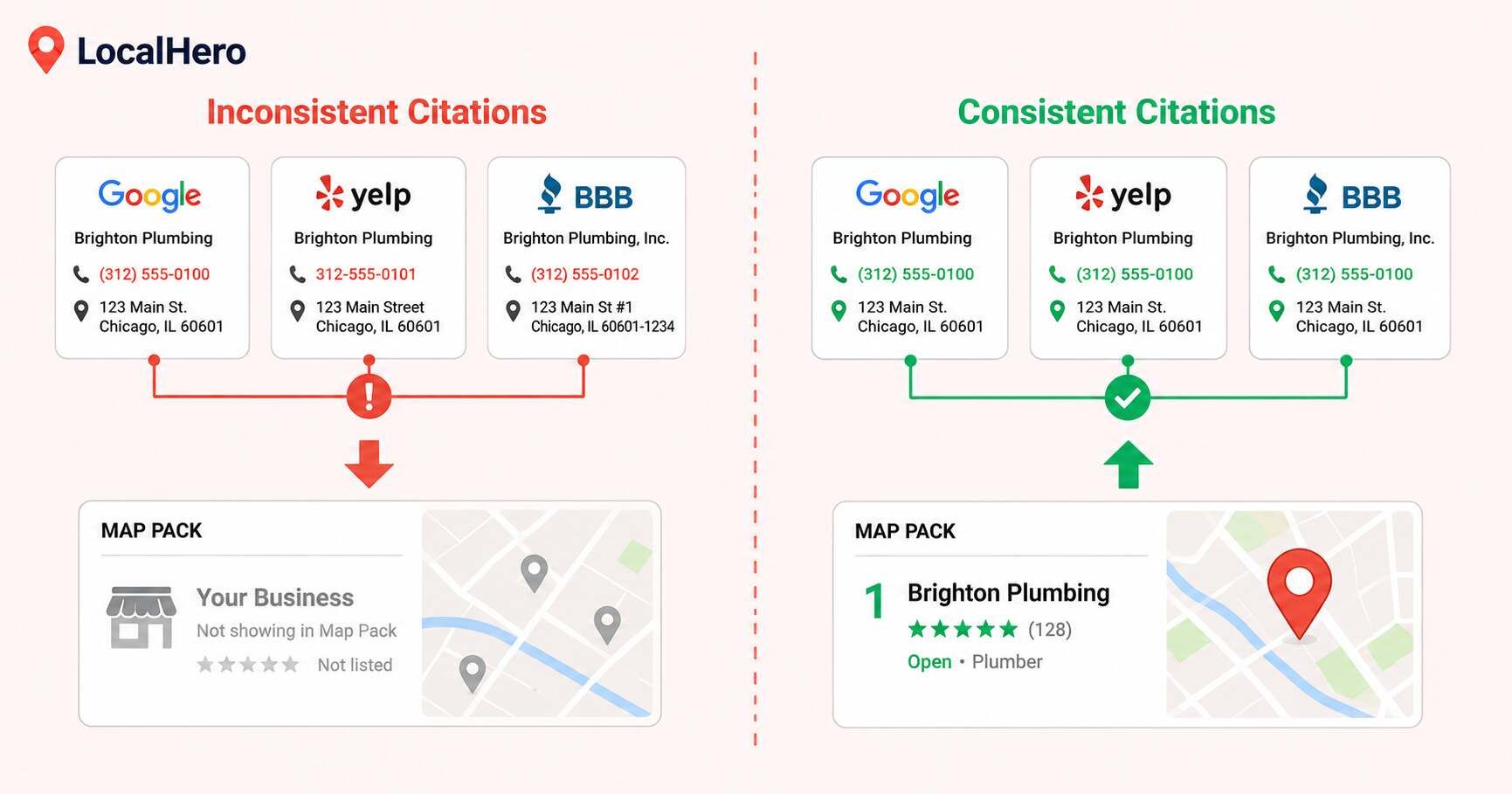
Every time your business name, address, and phone number appear on a directory site, that is a citation. Google collects these mentions across the web and uses them to verify your business is real, located where it claims, and operating in the category it claims.
When citations match, Google's confidence rises and your rankings follow. When they conflict, Map Pack visibility drops and often without any obvious reason.
This guide covers everything about local citation building in 2026 what citations are, how they affect your rankings, how to audit and clean up existing ones, how to build new ones correctly, and when to use a professional citation building service.
What Is Local Citation Building?
A local citation is any online mention of your business's Name, Address, and Phone number commonly called NAP. Citations appear on directory sites like Yelp, Apple Maps, and Yellow Pages, on industry-specific platforms, on social media profiles, and in local news articles.
Local citation building is the process of creating, correcting, and maintaining these mentions so they are accurate and consistent across the web. It is one of the foundational pillars of local SEO not because citations alone rank you, but because inconsistent citations actively undermine every other ranking signal you build.
There are two types:
Structured citations appear on directory platforms in formal fields name, address, phone, hours, category. These are the most common and have the strongest direct impact on local rankings.
Unstructured citations appear naturally in the body of a web page a news article mentioning your company, a local blog referencing your address. These build contextual trust through authority mentions.
Both matter. Structured citations validate your NAP data. Unstructured citations build entity authority.
Why Citations Still Matter for Rankings in 2026
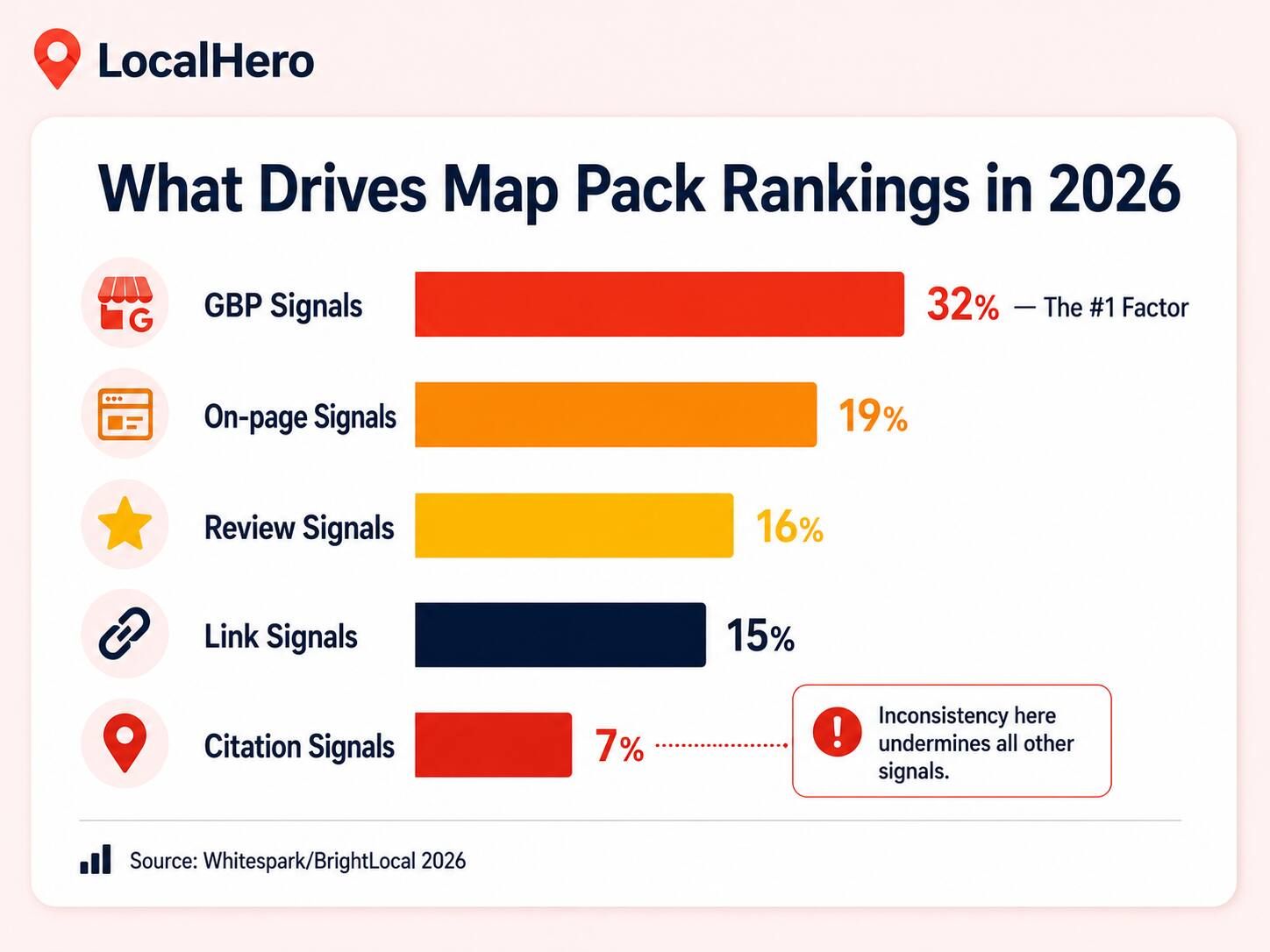
Citation signals account for approximately 7% of Google's local pack ranking weight, according to the Whitespark/BrightLocal Local Search Ranking Factors 2026 study. That places them fifth in the overall ranking factor hierarchy below GBP signals (32%), on-page signals (19%), review signals (16%), and link signals (15%).
Seven percent may sound modest. But citations play a role that goes beyond their direct ranking weight: they are the trust infrastructure that allows every other ranking signal to function properly.
Without accurate citations, your GBP optimizations will not yield their full ranking potential. A fully optimized Google Business Profile sitting on top of 15 conflicting directory listings is like a well-built house on an unstable foundation. The structure looks right, but the ground beneath it is shifting.
The stakes in 2026 are higher than they have been in years. Google AI Overviews, ChatGPT with web search, and Perplexity AI all pull business data from structured, consistent sources. Inconsistent data creates uncertainty for the model and uncertain data gets excluded from recommendations. Businesses with NAP inconsistencies across three or more citation sources are excluded from Google AI Mode local answers 74% of the time (Semrush, 2026).
The business case is concrete. Businesses with consistent NAP are 2.4x more likely to be considered reputable by local consumers. Businesses with 40+ accurate citations rank 53% higher in local search. Businesses fixing major NAP inconsistencies see a 17% average ranking improvement within 90 days. Citation cleanup is often the fastest-acting change in local SEO because it removes active confusion signals rather than adding new positive ones.
For a broader picture of how citations fit into the full local SEO ranking picture, see Local SEO Statistics 2026: 47 Data Points Every Service Business Should Know.
The 4 Tiers of Local Citations
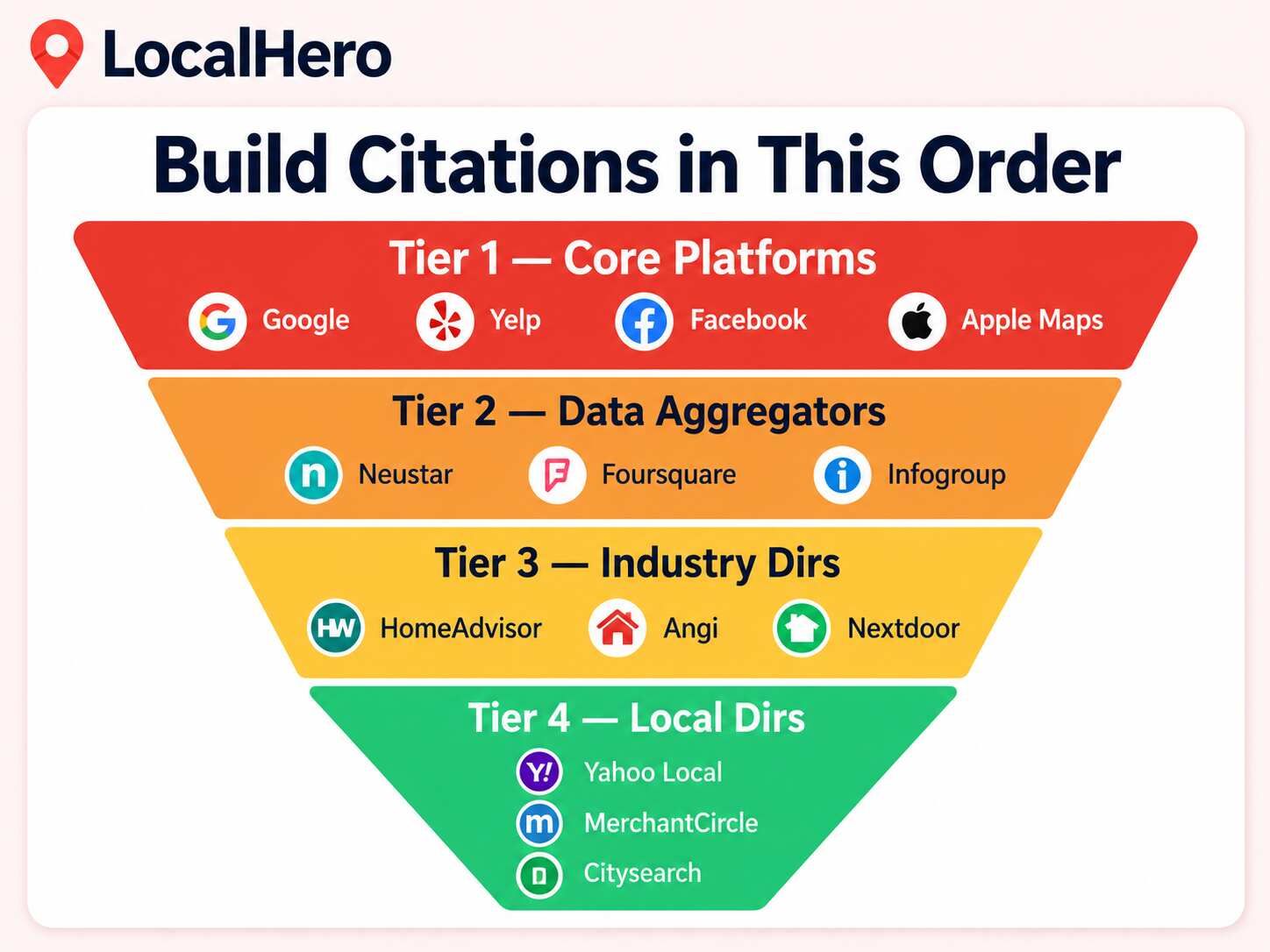
Not all citations carry equal weight. Local citation building is more effective when it follows a priority tier system starting with the highest-authority sources and building outward.
|
Tier |
What it includes |
Why it matters |
|---|---|---|
|
Tier 1 Core platforms |
Google Business Profile, Apple Maps, Yelp, Bing Places, Facebook, BBB |
Highest direct weight in Google's local algorithm |
|
Tier 2 Data aggregators |
Data Axle, Foursquare, Localeze |
Feed data to hundreds of downstream directories automatically |
|
Tier 3 Industry directories |
Houzz, Angi, Avvo, Healthgrades, Zocdoc, HomeAdvisor |
Add trade-specific authority and relevance |
|
Tier 4 Local directories |
Chamber of Commerce, city portals, regional news directories |
Add geographic specificity to your citation profile |
The data aggregators in Tier 2 deserve special attention. Most business owners focus exclusively on directories they can see Yelp, Facebook, BBB. But Data Axle, Foursquare, and Localeze feed your business data to hundreds of downstream directories automatically. If these aggregators have your old phone number or previous address on file, that bad data keeps propagating to new directories long after you think the problem is fixed. Fixing the aggregators stops the spread at the source.
Most local service businesses need 40 to 80 accurate, consistent citations to be competitive. More important than the total count is accuracy 50 consistent citations consistently outperform 200 inconsistent ones in Google's local algorithm. The right number for your market depends on your competition. A plumber in a smaller city may need 30 to 40 citations, while a dentist in a major metro may need 60 to 80+.
Step 1: Run a Full NAP Audit Before You Build Anything
The biggest mistake in local citation building is adding new citations before fixing the broken ones. If your old phone number is listed on 20 directories and you add 20 new correct listings, you now have 40 listings with conflicting data twice the problem.
Start with a full audit of your existing NAP footprint:
-
Search your exact business name in quotes: "Smith Plumbing". Every result is a potential citation.
-
Search your old phone number any number you used before your current one. Old numbers stay on directories until manually corrected.
-
Search your old address if you have moved in the past five years.
-
Check your business name variations legal name, DBA, shortened name. Different versions create inconsistency even when address and phone match.
-
Use a citation audit tool like BrightLocal or Whitespark to scan 100+ networks simultaneously.
Log every result in a spreadsheet: platform, URL, current data, and what needs fixing.
64% of businesses have NAP inconsistencies in at least one major directory. Most business owners do not know which listings are wrong until they run this audit. The findings are almost always worse than expected.
Download LocalHero's citation cleanup worksheet a fillable tracker covering the top 40 US directories with a prioritized fix order.
For a complete walkthrough of diagnosing and fixing your NAP inconsistencies, see How to Fix Wrong Business Information That's Killing Your Rankings.
Step 2: Fix Your Data Aggregators First
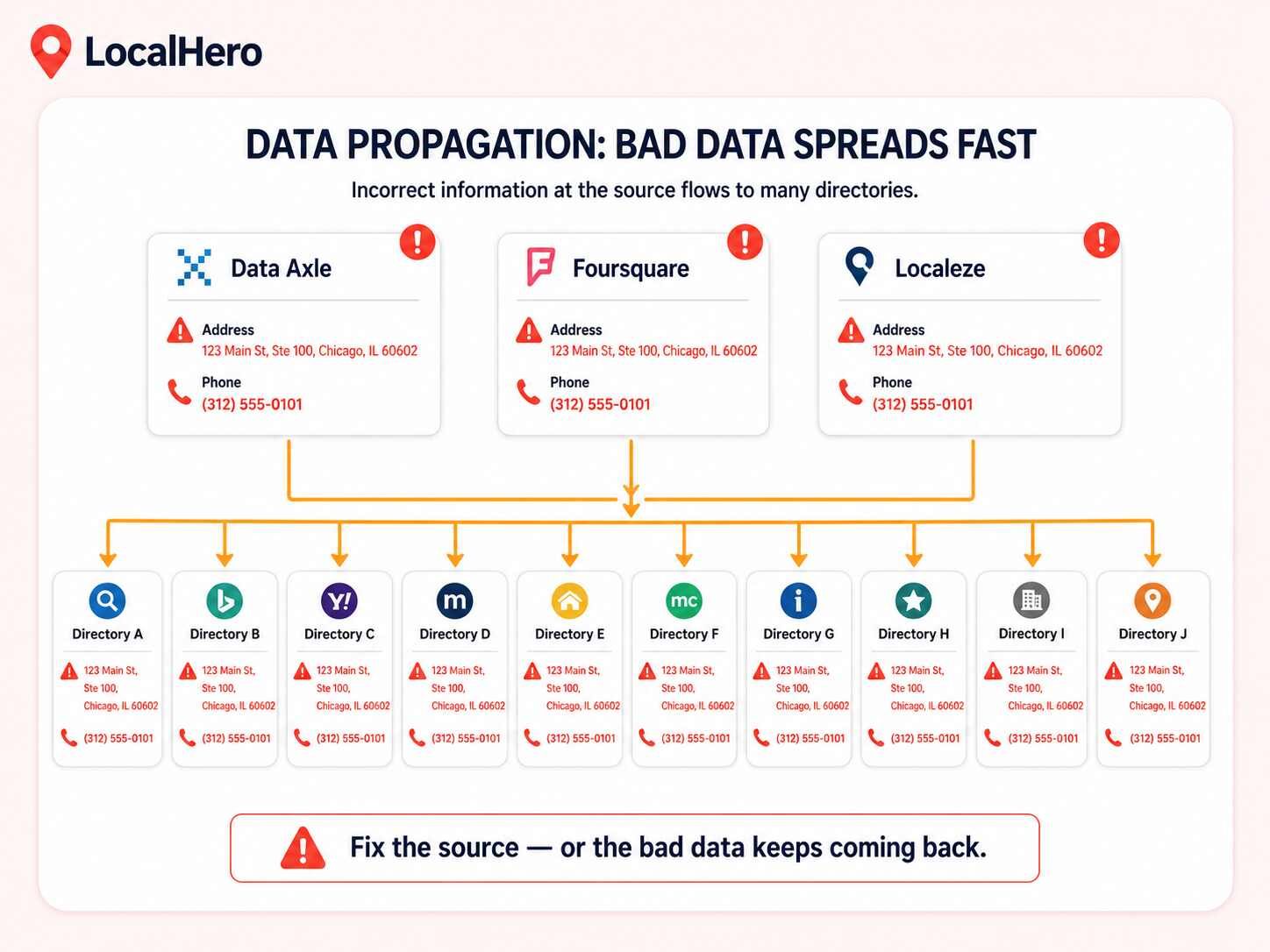
Before building a single new citation, correct your data at the aggregator level. This step is the one most businesses skip and it explains why citation problems keep coming back even after hours of manual cleanup.
The four major US data aggregators are:
-
Data Axle (formerly InfoUSA) the largest aggregator, feeding data to hundreds of directories
-
Foursquare feeds mapping platforms, apps, and location-based services
-
Localeze (Neustar) major feed for GPS systems and navigation platforms
-
Factual feeds mobile apps and data partners
Here is how this creates recurring problems. A business owner updates Yelp after moving offices. But Data Axle still has the old address on file. Over the next 60 to 90 days, Data Axle pushes that old address to every directory it feeds overwriting the manual corrections automatically.
Fix the aggregators before building anywhere else. Fixing downstream directories first without correcting the source is like bailing water without plugging the leak.
Step 3: Build Tier-1 Citations
With your aggregators fixed and your existing citations audited, now build clean, verified listings on the highest-authority Tier-1 platforms.
Work through them in this order:
-
Google Business Profile the most important citation of all. See the Google Business Profile Checklist for the full optimization steps.
-
Apple Business Connect feeds Apple Maps and Siri. Claim at businessconnect.apple.com.
-
Yelp high-authority and heavily indexed. Claim, update NAP, add photos.
-
Bing Places sync to match your GBP data exactly.
-
Facebook Business Page update the About section with consistent NAP.
-
Better Business Bureau significant trust weight, especially in service industries.
For each: claim if unclaimed, update every field to match your master NAP, verify ownership, and screenshot for your records.
Pro tip: Create a single master NAP document before touching any listing. Every field on every platform must match it character for character including whether you spell out "Street" or abbreviate it as "St." That level of consistency is what Google is actually checking.
Step 4: Add Industry-Specific and Local Citations
After Tier-1 is clean, add the industry-specific directories that carry relevance weight for your trade and the local directories that add geographic specificity.
Industry-specific directories by trade:
|
Industry |
Key directories |
|---|---|
|
Contractors, HVAC, plumbers |
Angi, Houzz, HomeAdvisor, Thumbtack |
|
Attorneys, law firms |
Avvo, Martindale-Hubbell, FindLaw, Justia |
|
Dentists, medical practices |
Healthgrades, Zocdoc, WebMD, Vitals |
|
Auto repair, auto services |
AutoMD, RepairPal, CARFAX Service Advisor |
|
General home services |
Thumbtack, TaskRabbit, Porch |
These directories carry relevance signals specific to your trade they are the kind of citation Google treats as confirmation that you actually operate in the category you claim. A plumber with consistent NAP on Angi and HomeAdvisor sends a much stronger relevance signal than a plumber with NAP only on general directories.
Local directories to add:
-
Your city or county Chamber of Commerce
-
Local business improvement district directories
-
Regional news site business listings
-
City-specific business portals
Structured citations excel at precise NAP validation and syndication, and tend to have a stronger direct impact on local rankings than unstructured mentions. Unstructured citations build contextual trust through high-authority mentions on relevant local sources. A single mention in a local newspaper or business blog counts as an unstructured citation and for hyper-local signals, these can be powerful.
For help combining your citation profile with local backlinks for a complete local authority strategy, see Local SEO Backlinks: 7 Free Ways to Build Them and LocalHero's local link building service.
The NAP+W Rule Every Citation Must Follow
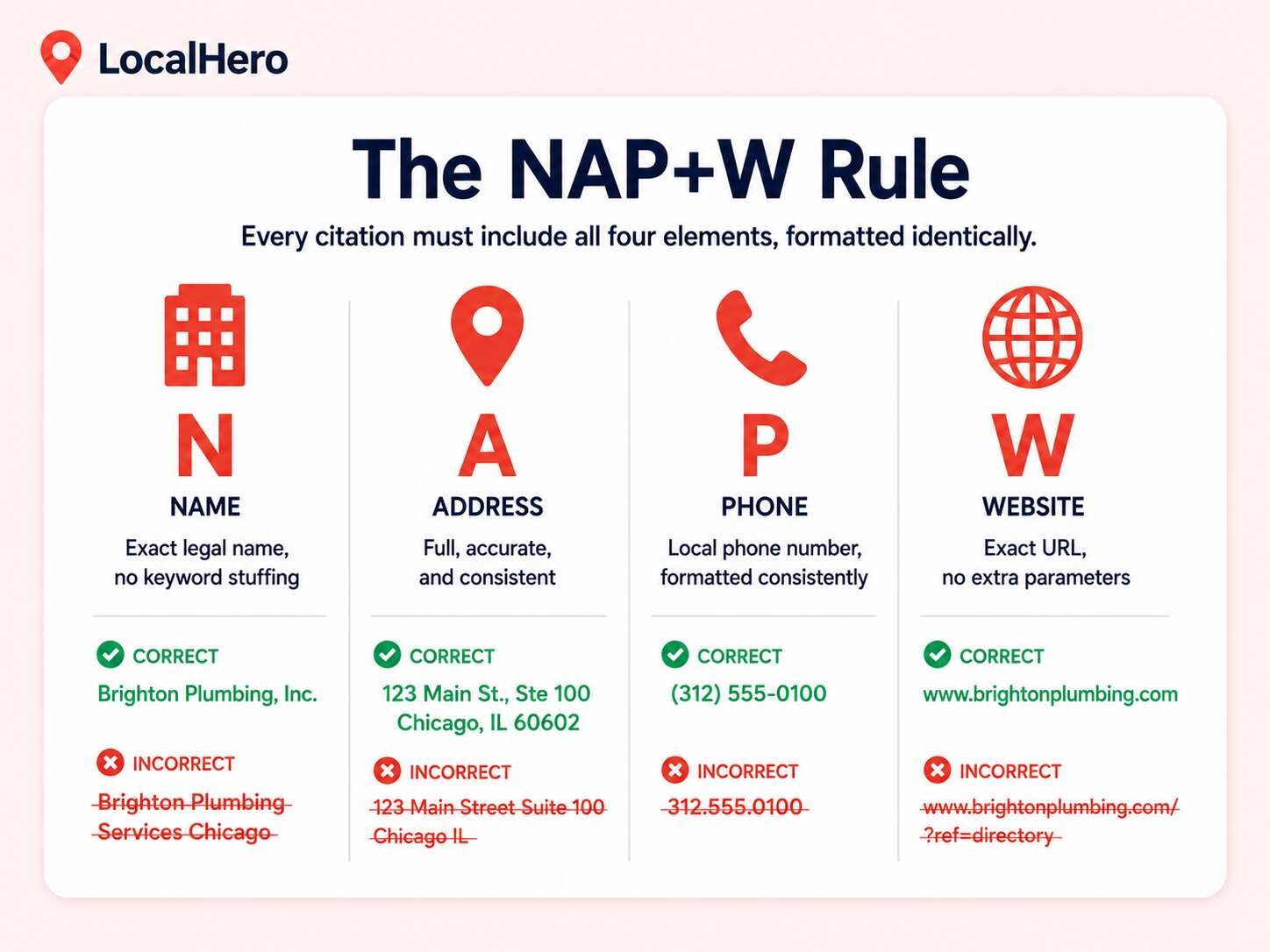
Standard citation advice focuses on Name, Address, and Phone NAP. LocalHero adds a fourth element: Website URL. Every citation you build should follow the NAP+W rule.
Here is exactly what each element requires:
Name: Your exact legal business name no added keywords, no shortened versions, no variations. If your LLC is registered as "Smith Plumbing LLC," every citation reads "Smith Plumbing LLC" not "Smith Plumbing," not "Smith's Plumbing."
Address: USPS-standard format. Use the USPS ZIP Code Lookup tool to find the standardized version of your address, then apply it everywhere with zero variation. "Suite 100," "Ste. 100," and "#100" are three different addresses in Google's data model.
Phone: One primary local phone number, one format. Choose between (555) 123-4567 and 555-123-4567 and use it on every platform without switching.
Website (W): The URL of your specific location or service landing page not just your homepage. If your business has a plumbing service page at /services/plumbing-[city], link to that page from each citation. This reinforces the connection between your NAP data and your service-specific web content.
Warning: Using a call-tracking number as your primary citation phone number creates a NAP mismatch between your citations and your GBP. Either use your real number everywhere, or ensure your tracking number is consistent across all citations and your GBP.
Manual vs. Automated Citation: Why Manual Citation Wins Long-Term
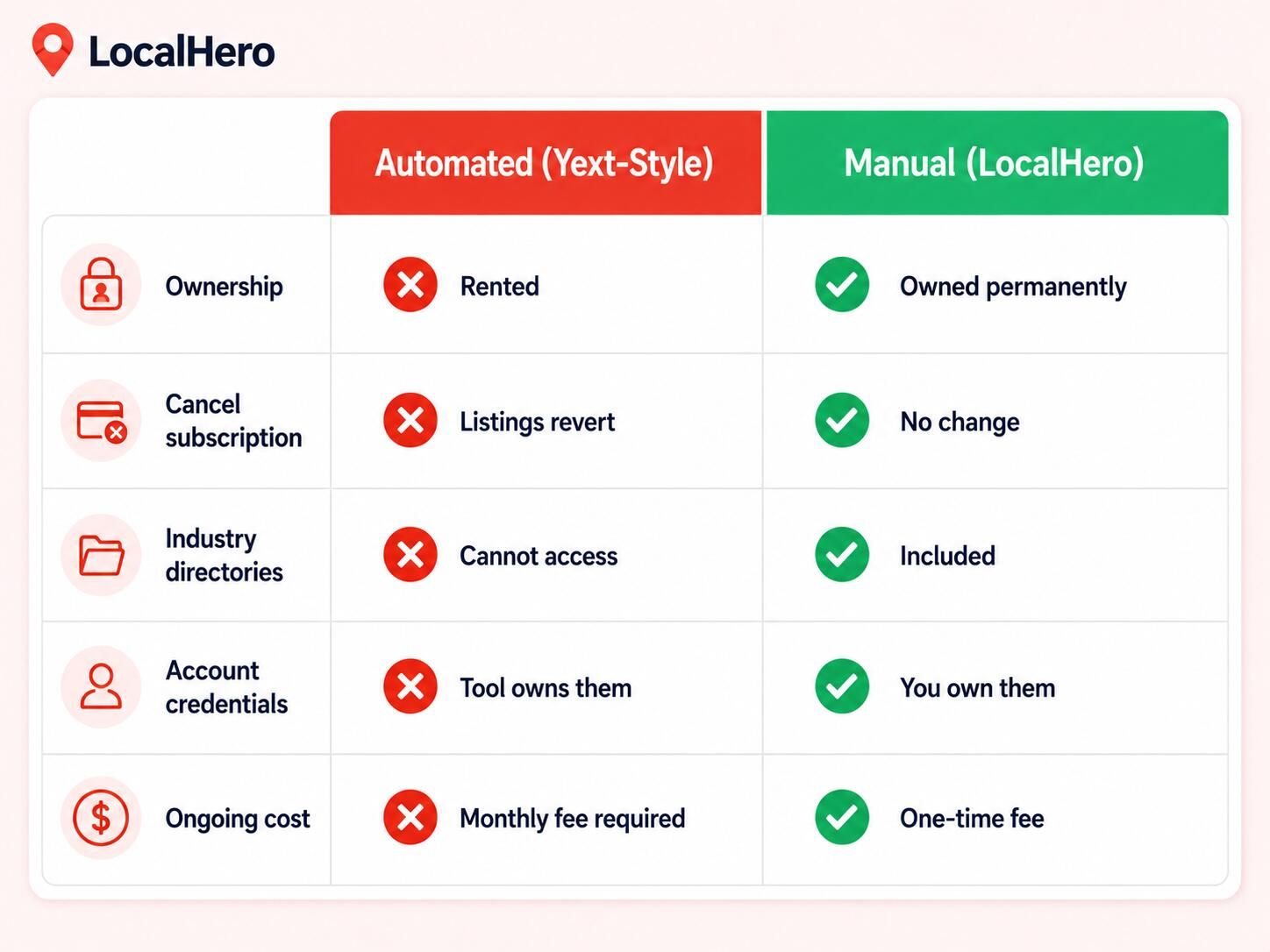
Automated citation services like Yext and Moz Local look appealing they promise wide distribution with minimal effort. But they come with a fundamental problem: they rent your citations, not build them.
Here is how the rental model works. When you subscribe, the tool pushes your data to its partner directory network. When you cancel, every listing reverts to whatever data those directories had before often the same old address you were trying to fix.
Manual building claims each listing permanently with your own account credentials. You own the logins. You own the data. No subscription required to keep your address correct.
Manual also allows industry-specific placement. Automated tools cannot access Avvo, Healthgrades, Justia, or RepairPal the trade-specific platforms that carry the strongest relevance signals for service businesses.
LocalHero's citation building service uses a manual-only approach across 50+ directories, including industry-specific platforms that automated tools miss entirely.
How Long Does Citation Building Take to Work?
Timeline expectations vary depending on the starting state of your citations and what specifically needs fixing.
|
Action taken |
Typical timeline |
|---|---|
|
Fixing major NAP inconsistencies (old address, wrong phone) |
4-6 weeks to see ranking improvement |
|
Fixing data aggregators |
30-60 days to propagate across downstream directories |
|
Building new Tier-1 citations on clean profile |
30-60 days to register in Google's algorithm |
|
Adding industry-specific directories |
60-90 days for full impact |
|
Full citation build from scratch |
60-90 days for meaningful visibility improvement |
The fastest results come from fixing existing problems, not building new citations. An HVAC company LocalHero worked with had moved three times in ten years leaving 60+ conflicting citations across the web. Google dropped their Map Pack rankings entirely. After one month of forensic cleanup and duplicate suppression, they returned to position #1 for their primary service keyword.
Citation cleanup consistently produces faster ranking movement than new builds because it removes active trust damage rather than adding positive signals on top of it.
Common Citation Mistakes That Kill Rankings
These are the errors we see most consistently when auditing local service businesses:
-
Building new citations before cleaning up old ones. 30 correct listings on top of 20 incorrect ones doubles your inconsistency not your visibility.
-
Using different name variations across platforms. "Smith Plumbing," "Smith's Plumbing," and "Smith Plumbing Services" are three different entities in Google's data model.
-
Ignoring data aggregators. Fixing Yelp while Data Axle still has your old address means the bad data keeps returning.
-
Using a P.O. Box as your address. Google requires a physically verifiable address P.O. Boxes trigger listing suppression.
-
Building on low-quality spam directories. 50 authoritative citations outperform 500 low-quality ones. Volume without quality is not a strategy.
-
Never checking for duplicates. Multiple listings on the same platform split trust signals and confuse Google's entity resolution.
-
Treating citation building as a one-time project. Without ongoing monitoring, citation consistency degrades as aggregators overwrite your corrections with old data.
Checklist: Local Citation Building for Service Businesses
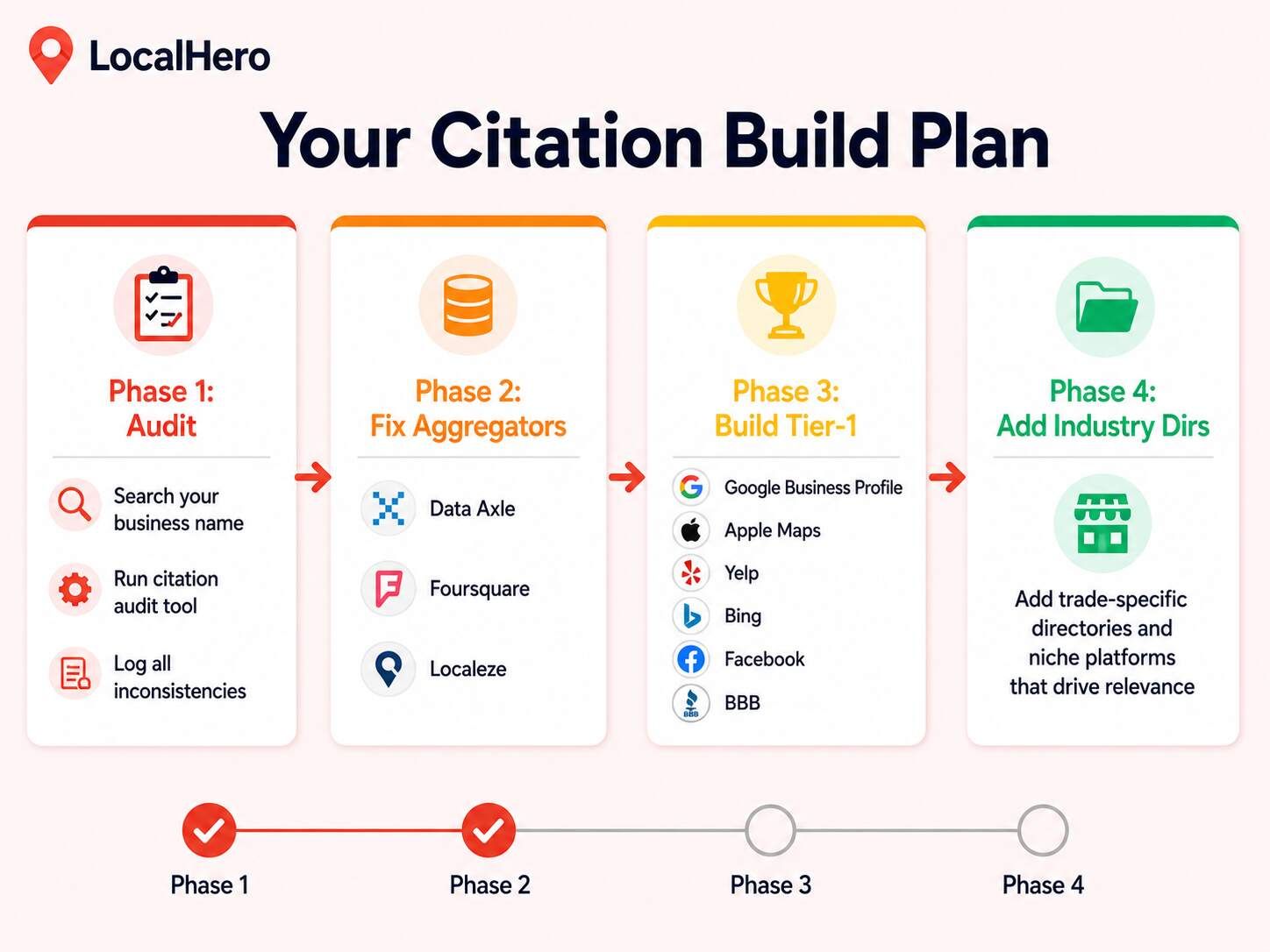
Use this to confirm every step of your citation build is complete:
-
Create a master NAP+W document exact business name, USPS-standard address, primary phone, and website URL.
-
Audit your existing citations search your business name, old phone number, and old address.
-
Run a citation audit tool (BrightLocal, Whitespark) across 100+ networks and log every inconsistency.
-
Fix your data aggregators: Data Axle, Foursquare, and Localeze.
-
Suppress or merge every duplicate listing you found in the audit.
-
Claim and correct your Google Business Profile the most important citation of all.
-
Build clean listings on Apple Maps, Yelp, Bing Places, Facebook, and BBB.
-
Add citations on the 3-5 industry-specific directories most relevant to your trade.
-
Add local citations on your Chamber of Commerce and city-specific directories.
-
Download and use the citation cleanup worksheet to track every listing status.
-
Set a quarterly reminder to spot-check your top 10 directories for data drift.
-
Run a free SEO audit to see your current citation consistency score alongside other local ranking factors.
For a complete local SEO audit that scores citations alongside GBP, reviews, and website signals, see How to Do a Local SEO Audit in 30 Minutes.
When Does a Citation Building Service Make Sense?
DIY citation building is manageable for the top 10-15 directories. The challenge is scale and maintenance submitting to 50+ directories with perfectly formatted NAP+W data takes 15 to 20 hours, and data aggregators regularly overwrite your corrections with outdated data unless you monitor consistently.
A citation building service makes the most sense when:
-
Your business has moved and old addresses are circulating across dozens of directories.
-
You have changed your phone number and the old number still appears in many places.
-
You have rebranded and old name variations are still active online.
-
You rank for your name but not for service searches a classic citation inconsistency signal.
-
You have been in business five or more years and have never audited your citation profile.
LocalHero's citation building service handles the full process forensic audit, data aggregator correction, duplicate suppression, Tier-1 and industry-specific build, and ongoing monitoring. One-time cleanup runs $350-$600 depending on inconsistency volume; ongoing monitoring is $150/month to protect the consistency gains.
Citations work best as part of a complete local SEO system. For the full picture of how citations, GBP, reviews, and backlinks work together, see the Local SEO Checklist for Small Businesses and the local SEO services page.
Get a Free Citation Audit
If you are not sure whether citation inconsistency is hurting your rankings, a free local SEO audit from LocalHero will show you exactly where you stand.
We scan your business NAP across 100+ networks and report:
-
Every citation inconsistency and its source
-
All duplicate listings
-
Your data aggregator status
-
Tier-1 and industry-specific coverage gaps
-
AI search visibility whether inconsistent citations are excluding you from ChatGPT, Gemini, and Perplexity
Most businesses do not know they have a citation problem until they run the audit.
Get your free citation audit at localhero.live/contact
Related Local SEO Resources
Citations set the trust foundation. These resources take the rest of your local SEO the rest of the way:
- The 2026 Local SEO Checklist for Small Businesses. The complete step-by-step playbook.
- Local Backlinks: Best Backlinks for Local SEO. Layer authority on top of clean citations.
- Citation Building Service. Done-for-you audit, cleanup, and Tier-1 build.
- NAP Consistency: Why It Matters and How to Fix It. Fix the name, address, and phone conflicts behind most citation problems.
- Free Local SEO Audit. Check citation and NAP consistency issues right now.
Related reading
- Cleaning Company SEO. Citation cleanup is the first thing we fix for cleaning companies, and why it matters in this trade.
Frequently Asked Questions
What is citation building in local SEO?
Citation building is the process of creating, correcting, and maintaining online mentions of your business name, address, and phone number across directories, industry platforms, and local sites. Google uses these mentions to verify that your business is real and operating where it claims. Consistent citations build trust. Inconsistent ones reduce Google's confidence and lower your Map Pack rankings.
How many local citations does a business need?
Most local service businesses need 40 to 80 accurate, consistent citations to be competitive in the Map Pack. More important than the total count is accuracy — 50 consistent citations outperform 200 inconsistent ones. The right number depends on your market and competition. Always benchmark your citation count against the top three competitors in your local Map Pack, not an arbitrary number.
How long does citation building take to improve rankings?
Fixing major NAP inconsistencies typically produces ranking improvement within 4 to 6 weeks. New citation builds take 30 to 60 days to register in Google's local algorithm. Data aggregator corrections take 30 to 60 days to propagate across downstream directories. Full citation cleanup projects on heavily inconsistent profiles typically show meaningful ranking movement within 60 to 90 days.
Should I use Yext or a manual citation building service?
Automated tools like Yext rent your citations — when you cancel, listings revert to incorrect data. Manual citation building permanently claims each listing with your own account credentials. You own the data forever with no recurring subscription to keep your address correct. Manual building also allows placement in industry-specific directories that automated tools cannot access. For most local service businesses, manual citation building is the right long-term approach.
What is the NAP+W rule for local citations?
NAP+W stands for Name, Address, Phone number, and Website URL. Every citation should include all four elements, and each must be formatted identically across every platform. Name must match your legal business name exactly. Address must follow USPS-standard format. Phone must use one consistent format. Website should link to your most relevant service or location page, not just the homepage. Even small format differences — "St." vs. "Street," "(555)" vs. "555" — count as inconsistencies in Google's data model.
How much does citations building cost in 2026?
Citations building costs $150 to $600 for a one-time audit and tier-1 build for a single-location business. Multi-location businesses and franchises range from $600 to $1,500 depending on volume and existing inconsistencies. Ongoing citation monitoring adds $50 to $200 per month. DIY citations building costs $0 in fees but consumes 15 to 20 hours to submit accurately to 50+ directories, and most business owners never revisit the listings once submitted, which is where consistency breaks down.
What's the difference between local citations and backlinks?
A local citation is a mention of your business name, address, and phone number on a directory or business listing, with or without a hyperlink. A backlink is a hyperlink from another website to yours that passes domain authority. Citations verify to Google that your business is real, located where it claims, and operating in the category listed. Backlinks pass ranking authority through the link graph. Citations move Map Pack rankings faster; backlinks move organic rankings. Every local business needs both.
Which are the best local citation directories in 2026?
The best local citation directories in 2026 by ranking impact are: Google Business Profile, Apple Business Connect, Yelp, Bing Places, Facebook Business, and the Better Business Bureau. After those, the four US data aggregators (Data Axle, Foursquare, Localeze, Factual) feed hundreds of downstream directories automatically. Industry-specific citations matter next: Healthgrades and Zocdoc for medical, Avvo for legal, Houzz and Angi for contractors, HomeAdvisor for home services. Local city directories and Chamber of Commerce listings round out the list.
Do I still need citations building if my Google Business Profile is fully optimized?
Yes. A fully optimized Google Business Profile establishes your business on the most important listing, but Google cross-references your NAP against the wider web to verify the profile is accurate. Without consistent citations on Apple Maps, Yelp, Bing Places, and the data aggregators, Google treats your GBP data as unconfirmed and ranks it below competitors whose data is verified across many sources. Citations building is not optional even for businesses with strong GBPs, it is the trust layer underneath them.
Md Shakil Jamal
Co-Founder | Digital Marketing Manager and DEV
Md Shakil Jamal is the co-founder of LocalHero and an SEO content strategist. He helps local businesses rank higher on Google, appear in AI search results, and turn online visibility into business growth. Connect with him on LinkedIn.
More local SEO playbooks
Ready to be the local hero in your city?
Get a free local SEO audit of your site, Google Business Profile, citations, and top three Map Pack competitors. You will see exactly where you can win in 30 seconds.
- No long term contracts
- No lock in
- Cancel anytime