Local SEO for Auto Repair Shops: The Complete Guide
Table of Contents
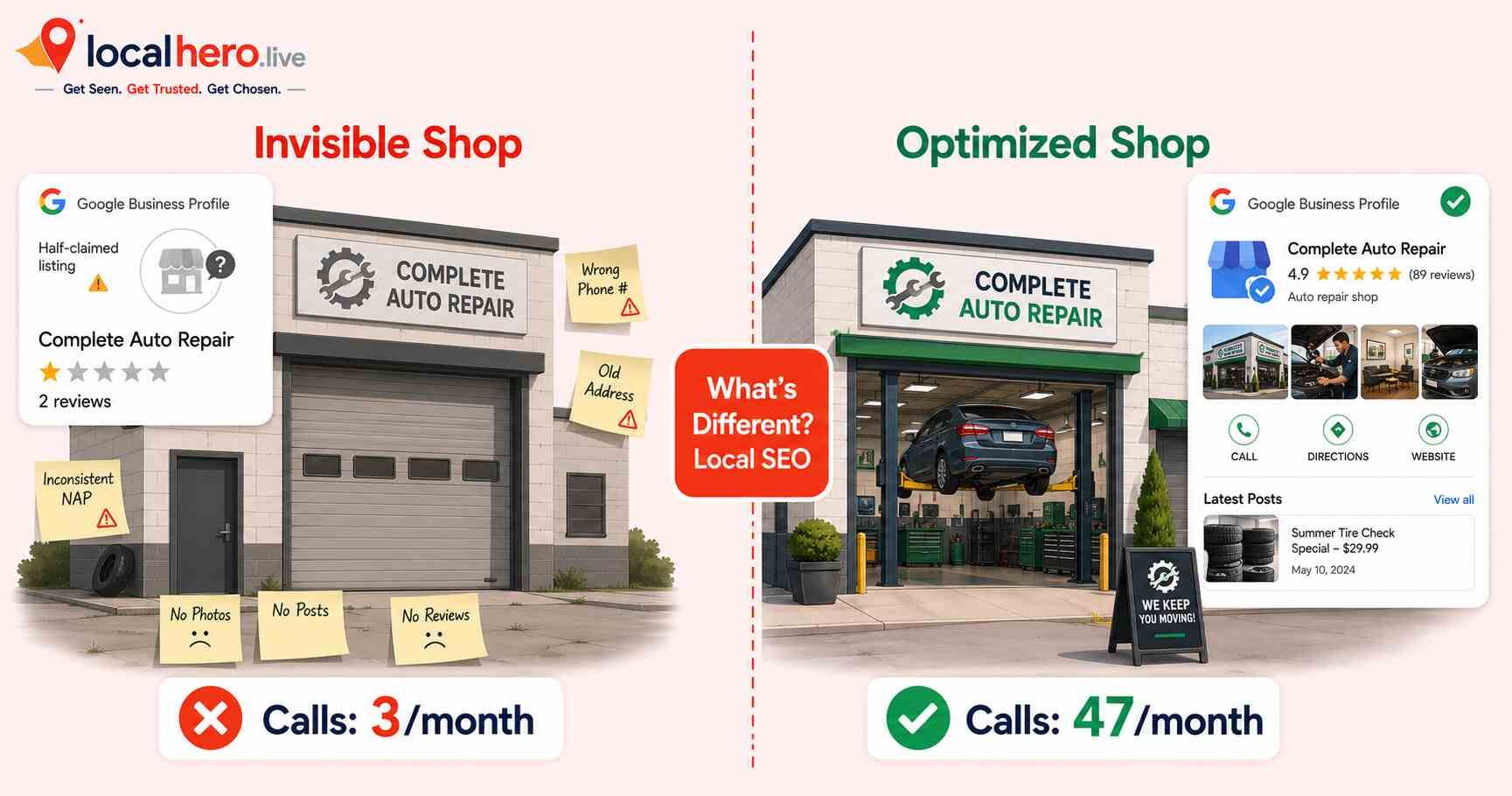
A driver's check engine light comes on. They pull over, grab their phone, and search "mechanic near me." Within 30 seconds they are looking at three auto repair shops in the Map Pack. They read the reviews, see who has photos of real work, check the hours, and call whoever looks most trustworthy. The shop that answers fills a bay. The other two never got the chance.
That moment — repeated hundreds of times every day in your city — is what auto repair SEO is built around. Shops landing in Google's local 3-pack receive 126% more traffic and 93% more engagement than shops in positions four through ten. If your shop is not in those three spots, you are fighting for the scraps.
This guide covers every element of local SEO for auto repair shops — from your Google Business Profile to service-specific pages to the review system that separates trusted shops from invisible ones.
Why Auto Repair SEO Is Different From Other Local Businesses
Auto repair shops face a challenge that most local service businesses do not: a trust gap that exists before any search begins. Drivers already worry about being overcharged or oversold. That skepticism means your online presence has to work harder than a plumber's or HVAC company's. Reviews, photos, and transparency are not nice-to-haves — they are load-bearing elements of your local SEO strategy.
Three things make auto repair SEO uniquely high-stakes:
Trust is the primary conversion factor. 41% of consumers now "always" read reviews when evaluating an auto repair shop — up from 29% the year before. And 31% will only use a business with an average rating of 4.5 stars or higher, up sharply from 17% in 2025. A shop with great rankings but weak reviews loses the conversion to a shop with fewer rankings and better reviews.
Urgency drives most searches. When a transmission fails or a car won't start, the customer is not comparison shopping. They are calling the first shop that looks reliable. Almost every auto repair search has local intent baked in — even when the searcher does not type "near me." Google assumes it.
Competition is beatable. Most auto repair shops invest in physical signage and mailers while their online presence consists of a website built in 2014 and a half-claimed Google Business Profile. The shops that take auto repair SEO seriously almost always dominate their local market because their competitors simply do not.
For a broader look at how local search behavior drives these patterns, see Local SEO Statistics 2026: 47 Data Points Every Service Business Should Know.
How Google Ranks Auto Repair Shops
Google uses three factors to decide which auto repair shops appear in local search: relevance, distance, and prominence. Understanding all three tells you exactly where to focus.
|
Factor |
What it means for auto repair shops |
How to strengthen it |
|---|---|---|
|
Relevance |
Your profile and site match the search |
Correct category, full service list, service pages |
|
Distance |
How close you are to the searcher |
Accurate service area, location-specific content |
|
Prominence |
How trusted and well-known you appear |
Reviews, citations, backlinks, active GBP |
Relevance means Google can confirm you offer the specific service searched. A shop listed only as "Auto Repair Shop" with no detailed services misses searches for "brake repair," "oil change near me," and "transmission shop [city]" — all of which a competitor with a detailed profile wins.
Distance is largely fixed — your shop is where it is. But you can compete beyond your immediate radius by building stronger prominence signals that tell Google you are the most trusted option in the area.
Prominence is where most auto repair shops can close the gap on longer-established competitors. A shop with 350 recent reviews at 4.8 stars almost always outranks a competitor with 50 reviews at the same rating — regardless of which shop has been open longer.
For a complete breakdown of the Map Pack ranking system, see How to Show Up in Google's Map Pack: A Step-by-Step Guide.
The Auto Repair SEO Keyword Cluster Map
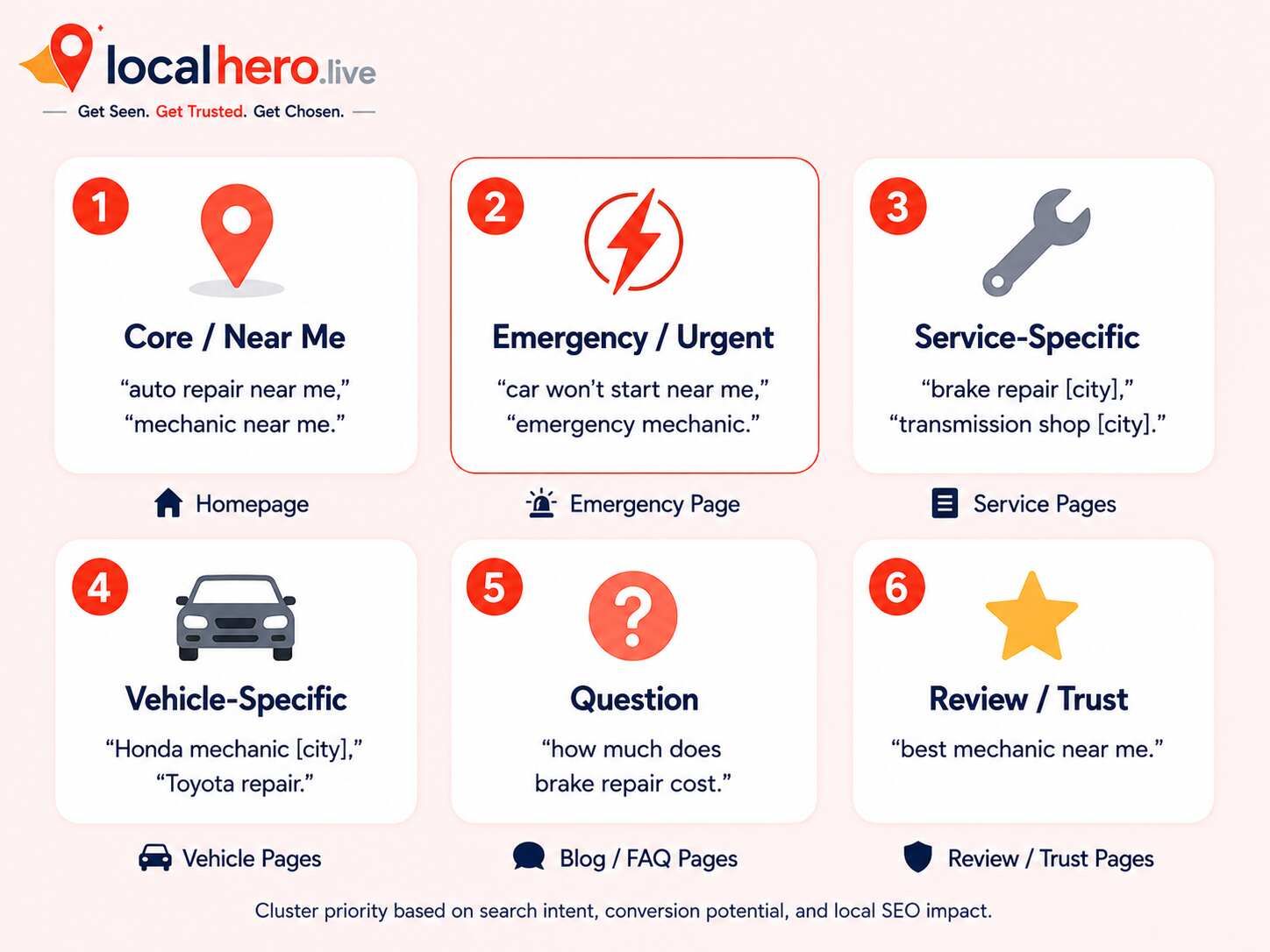
Effective auto repair SEO is not built around one or two keywords. It is built around clusters of search intent — each assigned to the right page on your website and the right section of your Google Business Profile.
|
Cluster |
Example keywords |
Search intent |
Where it belongs |
|---|---|---|---|
|
Core / near me |
"auto repair near me," "mechanic near me" |
Ready to call now |
Homepage, GBP category |
|
Emergency / urgent |
"car won't start near me," "emergency mechanic," "towing service near me" |
Crisis — needs help immediately |
Emergency page, GBP services |
|
Service-specific |
"brake repair [city]," "oil change near me," "transmission shop [city]" |
Looking for one specific service |
Individual service pages |
|
Vehicle-specific |
"Honda mechanic [city]," "Toyota repair near me," "BMW specialist" |
Brand loyalty or specialist need |
Make-specific pages or GBP services |
|
Question / research |
"how much does brake repair cost," "check engine light causes," "when to replace brakes" |
Researching before deciding |
Blog posts, FAQ sections |
|
Review / trust |
"best mechanic near me," "honest auto repair [city]" |
Validating a choice |
Review responses, testimonials |
The emergency cluster and near-me cluster convert fastest — these are drivers with immediate problems. The service-specific cluster drives the highest-value work — a customer searching "transmission rebuild [city]" has already decided they need a transmission shop and is choosing one.
Build keyword clusters for your market using LocalHero's free local keyword generator — enter "auto repair" and your city to get 50+ organized keyword variations instantly.
Step 1: Optimize Your Auto Repair Google Business Profile
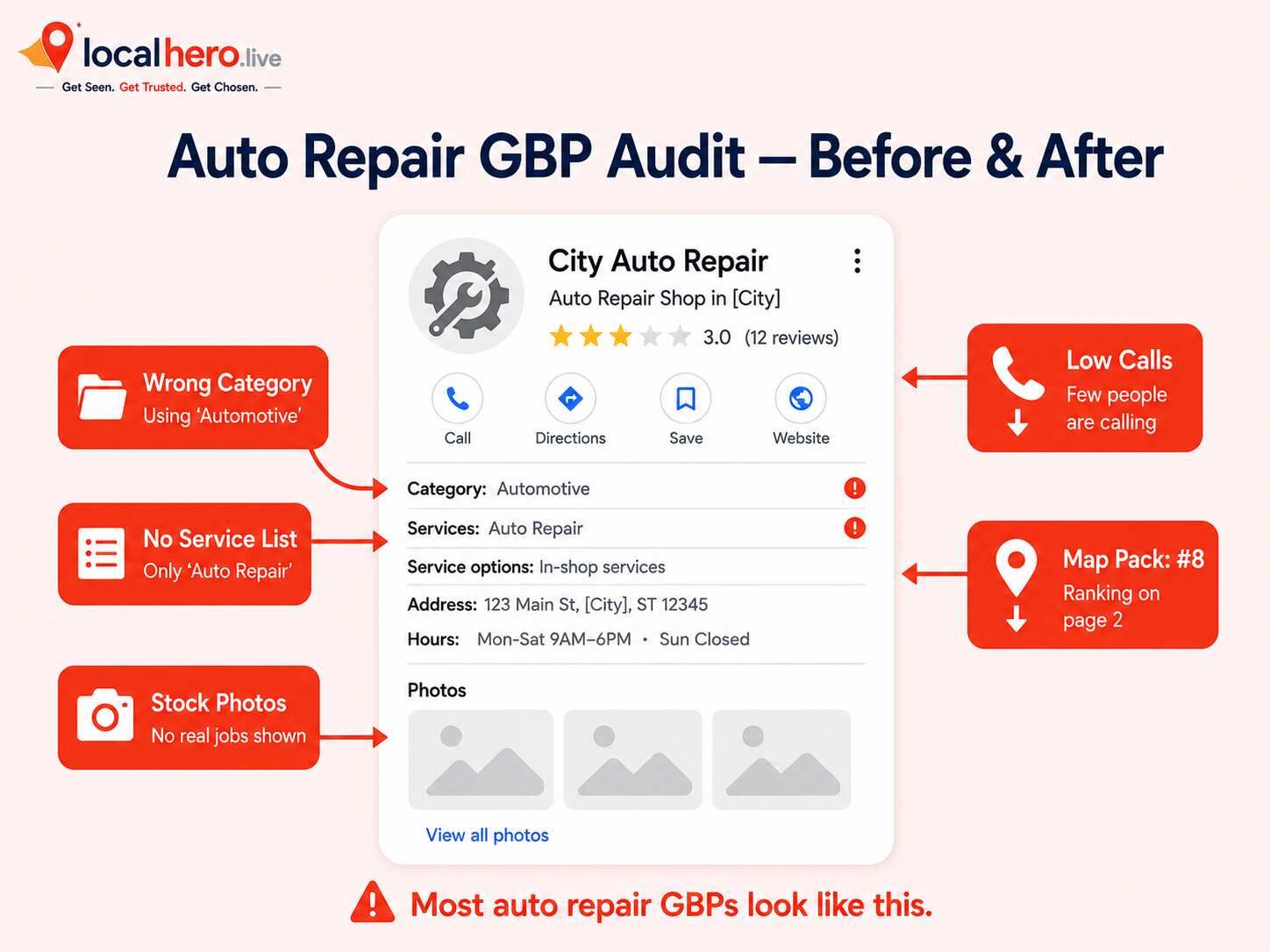
Your Google Business Profile is the single most important asset in auto repair SEO. Businesses with fully completed profiles receive up to 7 times more clicks than incomplete listings. For many shops, the GBP generates more calls than the website.
Here is how to optimize it specifically for an auto repair business:
-
Set your primary category to "Auto Repair Shop." Add secondary categories for every specific service you offer — "Brake Shop," "Transmission Shop," "Oil Change Service," "Tire Shop," "Auto Electrical Service." Each secondary category expands which searches you match.
-
List every individual service with a description. "Brake inspection, pad and rotor replacement, brake fluid flush" is better than "Brake Service." Each individual service entry is a keyword match for a specific search.
-
Upload real photos of your shop and work. Businesses with photos get 42% more direction requests. Show your bays, your team, your equipment, and before-and-after shots of actual repairs. Never use stock photos.
-
Add real business hours and holiday schedules. Drivers searching late or on weekends need to know immediately if you are open. Wrong hours cost you calls.
-
Activate your appointment booking URL. If you use a scheduling tool like Tekmetric, Mitchell, or a booking page, link it directly in your GBP.
-
Post weekly. Seasonal content performs well — "Summer AC Recharge Specials," "Back to School Safety Inspection," "Pre-Winter Tire Check." Posts signal an active business.
-
Populate your Q&A section. Answer: "Do you offer free diagnostics?" "What brands do you service?" "Do you offer a warranty on repairs?" This content captures exact search queries.
For a complete audit of your current profile before making changes, see We Audited 50 Google Business Profiles — Here's What 80% Get Wrong.
For ongoing profile management, see LocalHero's Google Business Profile service.
Step 2: Build Service-Specific Pages for Every Repair You Offer
Your homepage cannot rank for "brake repair [city]" and "transmission shop [city]" and "oil change near me" simultaneously. Google ranks pages, not websites. Each high-value service needs its own dedicated page.
Build individual pages for:
-
Brake repair and replacement — target "brake repair [city]," "brake pad replacement near me"
-
Oil change services — target "oil change near me," "oil change [city]"
-
Transmission repair — target "transmission shop [city]," "transmission rebuild near me"
-
Engine diagnostics — target "check engine light [city]," "car diagnostic near me"
-
Tire services — target "tire shop near me," "[city] tire rotation," "tire replacement [city]"
-
AC service and repair — target "auto AC repair [city]," "car AC recharge near me"
-
Suspension and steering — target "alignment shop [city]," "suspension repair near me"
Each page needs:
-
The target keyword in the H1, title tag, and first paragraph
-
A clear description of the service in plain language
-
FAQ section using question-cluster keywords
-
FAQ schema markup for AI Overview eligibility
-
A click-to-call button above the fold
-
A real photo of the service being performed
Location-specific optimization increases rankings by up to 21%, and including city names in title tags improves rankings by 19%. "Brake Repair in [City] | Smith Auto" in your title tag outperforms "Brake Repair Services" every time.
For help building and optimizing service pages that convert, see LocalHero's website speed and conversion service.
Step 3: Build a Review System That Earns Trust
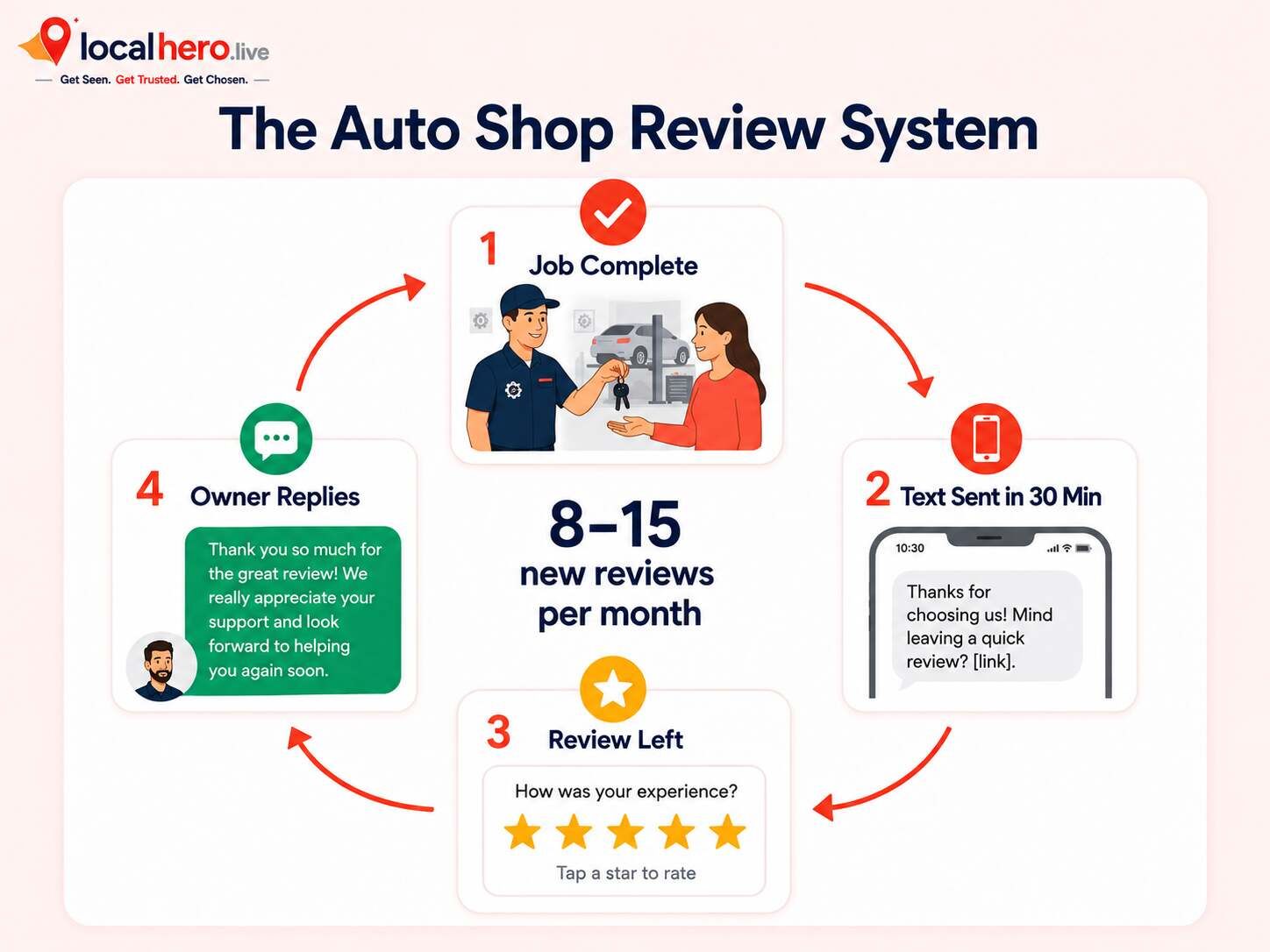
In auto repair, reviews do more than affect rankings — they close the sale. A driver comparing three shops in the Map Pack will choose the one with the most recent, detailed, trust-building reviews almost every time.
68% of consumers will not even consider an auto repair shop with an average rating below 4 stars. The review system is not optional — it is load-bearing infrastructure.
Here is the system that works:
-
Ask at vehicle pickup, while the customer is standing in front of you and their car is running. Satisfaction peaks at this moment.
-
Send a text with a direct Google review link within 30 minutes of pickup. Text converts significantly better than email for this audience.
-
Train service advisors — not just the shop owner — to ask. The person handling the customer transaction controls whether the ask happens.
-
Respond to every review within 48 hours. Positive reviews get a warm, specific thank-you. Negative reviews get a calm, professional response that acknowledges the concern and offers resolution offline.
-
Aim for 8 to 15 new reviews per month. Velocity and recency matter — a shop with 40 reviews arriving steadily over six months often outranks a shop with 200 reviews that stopped getting new ones.
Use LocalHero's free review response generator for non-generic, professional responses to any star rating. For a fully managed system, see review management services.
Pro tip: Download the review request templates pack — includes 5 SMS scripts under 160 characters and word-for-word scripts for responding to negative reviews, including the trust-sensitive "overcharging" complaints common in auto repair.
Step 4: Get Listed on Auto-Specific Directories and Citations
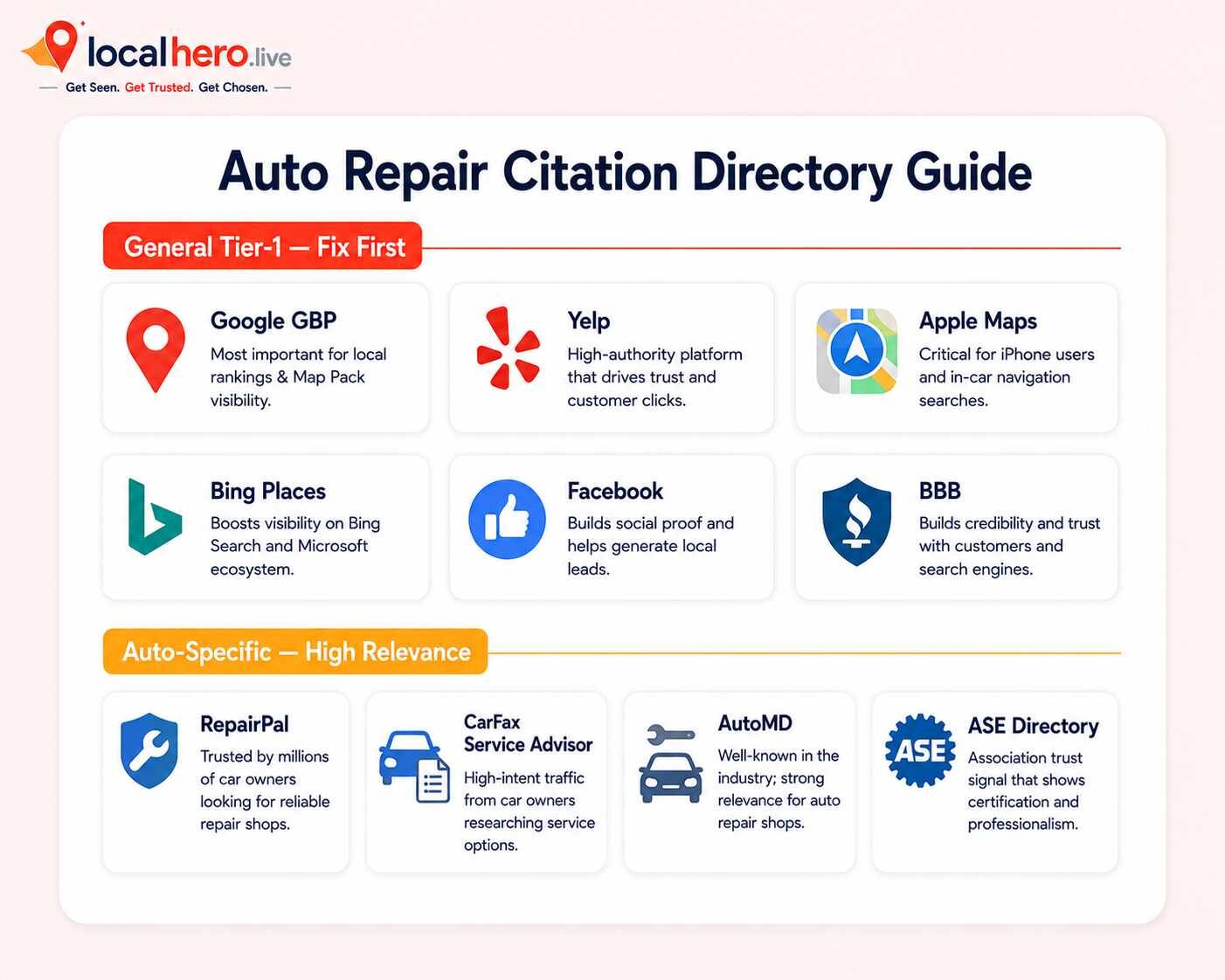
Auto repair shops benefit from two types of citation sources: general local directories and auto-specific platforms. The auto-specific ones carry category relevance that generic directories cannot provide.
General Tier-1 directories (fix and maintain):
-
Google Business Profile
-
Yelp
-
Apple Maps
-
Bing Places
-
Facebook Business
-
Better Business Bureau
Auto-specific directories (high-relevance citations):
-
RepairPal — heavily trusted by consumers, drives verified service leads
-
CarFax Service Advisor — high trust, integrates with vehicle history searches
-
AutoMD — automotive-specific consumer platform
-
NAPA Auto Care (if you are a member)
-
Firestone / Midas / Jiffy Lube directories (for franchises)
-
ASE-certified shop directories (if certified)
Every listing must show your business name, address, and phone number in exactly the same format. Even small inconsistencies — "St." vs "Street," "(555) 123-4567" vs "555-123-4567" — weaken Google's confidence in your location data. For the full NAP consistency walkthrough, see NAP Consistency: Why It Matters and How to Fix It.
LocalHero's citation building service handles the full audit, aggregator correction, and directory build — including auto-specific platforms that generic citation tools miss.
Step 5: Build Local Backlinks That Signal Authority
Backlinks from trusted, locally relevant sources tell Google that your shop is established and recognized in your community. For auto repair shops, the most valuable backlinks come from sources that are both local and automotive-adjacent.
Where to build auto repair backlinks:
-
Local Chamber of Commerce — the most accessible high-authority local link
-
AAA-approved shop directory (if eligible)
-
NAPA or AutoZone supplier pages — if they link to partner shops
-
Local news coverage — a shop anniversary, community sponsorship, or mechanic training program
-
Local car clubs and enthusiast communities — sponsorships often include website links
-
Community events — sponsor a local car show, charity race, or school fundraiser
-
Local fleet accounts — companies with vehicle fleets often list their service partners online
A single backlink from your city's Chamber of Commerce carries more weight than dozens of low-quality directory links. Do not buy backlinks — Google's algorithms detect unnatural patterns and the penalty cancels out any benefit.
For a practical list of free backlink methods, see Local SEO Backlinks: 7 Free Ways to Build Them. LocalHero's local link building service handles outreach and placement for shops that want this managed.
Step 6: Capture AI Search and Voice Discovery
In 2026, a growing portion of drivers ask ChatGPT, Gemini, or their car's voice assistant to recommend a mechanic before opening Google. Auto repair shops that generate steady leads build visibility across multiple discovery systems — including Google Maps, organic search, AI answers, automotive directories, and local reputation platforms.
The foundation of AI search visibility is the same as traditional local SEO: consistent NAP data, clear service descriptions, structured FAQ content, and genuine reviews. AI tools summarize what they can parse clearly — vague service entries get ignored, detailed ones get cited.
Three specific steps to improve AI visibility for your auto repair shop:
-
Add detailed FAQ content to every service page using your question-cluster keywords. "How long does a brake job take?" and "What is included in a transmission service?" are the exact types of questions voice search and AI answer.
-
Add LocalBusiness and AutoRepair schema markup to your homepage and service pages.
-
Check how ChatGPT and Perplexity describe your shop. Search your name and specialty. If the information is wrong or missing, the fix starts with your GBP and website content.
Common Auto Repair SEO Mistakes That Kill Rankings
These are the errors we see consistently across auto repair shops that should be ranking but are not:
-
Using "Automotive" or "Mechanic" as the primary GBP category instead of "Auto Repair Shop" — the wrong category makes you invisible to the most common search terms.
-
No individual service listings on the GBP — "Auto Repair" as the only entry misses every service-specific search.
-
No service pages on the website — one generic "Services" page cannot rank for brake repair, transmission service, and oil changes simultaneously.
-
Slow review velocity — 80 reviews with nothing new in six months is weaker than 40 reviews arriving steadily.
-
Responding to reviews with generic copy — "Thank you for your business!" on every review signals low engagement to Google.
-
Missing from RepairPal and CarFax — the two highest-trust auto-specific directories that drive qualified leads.
-
Keyword stuffing the business name — "Smith Auto Repair Brake Specialist Oil Change Shop" is a Google guidelines violation and risks profile suspension.
Checklist: SEO for Auto Repair Shops
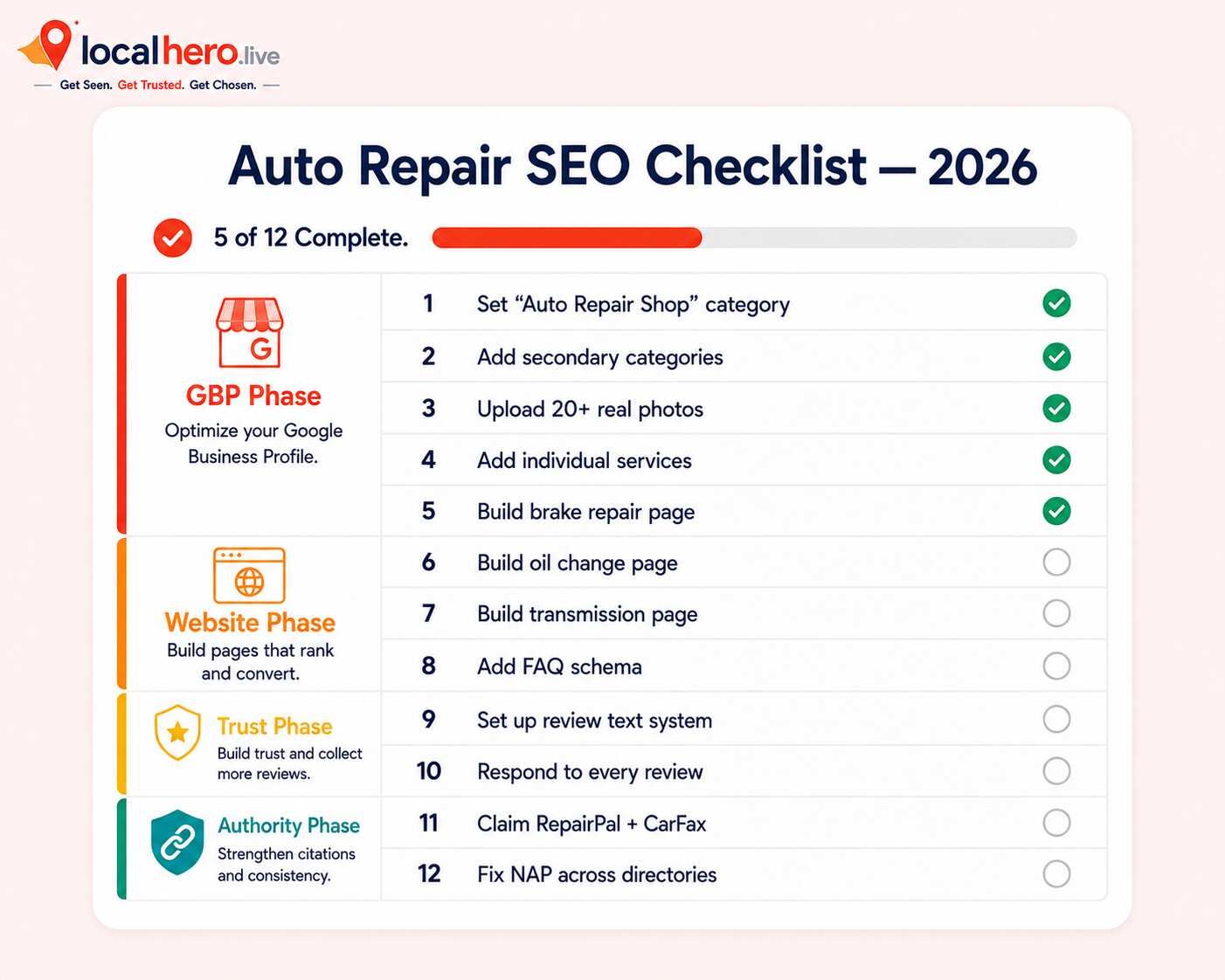
Use this to confirm every element is in place.
-
Set primary GBP category to "Auto Repair Shop" — add secondary categories for every specific service.
-
List every individual repair service in your GBP with a 2-3 sentence description.
-
Upload 20+ real photos: shop exterior, bays, team, equipment, before/after repairs.
-
Build dedicated service pages for brake repair, oil change, transmission, diagnostics, tires, and AC.
-
Add FAQ sections with schema markup to every service page.
-
Fix NAP consistency across all directories — use the citation cleanup worksheet.
-
Claim and complete your RepairPal and CarFax Service Advisor listings.
-
Set up a text-based review request system — target 8-15 new reviews per month.
-
Respond to every review within 48 hours using the review response generator.
-
Build at least one local backlink per month from community or automotive sources.
-
Add LocalBusiness schema and auto repair FAQ schema to your key pages.
-
Run a free local SEO audit to score your current presence across 17 ranking signals.
Get a Free Auto Repair SEO Audit
Not sure which part of your local SEO is holding back your rankings? A free local SEO audit from LocalHero will show you exactly where the gap is.
We audit:
-
GBP category accuracy and service section completeness
-
Review velocity, average rating, and response rate
-
Service page coverage and keyword alignment
-
Citation consistency across general and auto-specific directories
-
RepairPal, CarFax, and AutoMD listing status
-
Local backlink profile
-
AI search visibility across ChatGPT, Gemini, and Perplexity
-
Competitor comparison against the top three shops in your market
LocalHero's local SEO services are built for service businesses — the same system we use for plumbers, HVAC companies, and dentists applies directly to auto repair shops. The traffic channel is the same. The urgency is the same. The system is the same.
Get your free auto repair SEO audit at localhero.live/contact
Frequently Asked Questions
What is the most important local SEO factor for an auto repair shop?
Your Google Business Profile is the single most important factor. It directly controls your visibility in the Map Pack — the three listings that capture 126% more traffic than positions four through ten. Within the GBP, your primary category ("Auto Repair Shop") and your individual service listings are the two highest-impact elements. After the GBP, review velocity and response rate are the next most powerful signals — both for rankings and for converting searchers into callers.
How many Google reviews does an auto repair shop need to rank?
There is no fixed threshold, but 40 to 80 recent reviews above 4.5 stars is typically enough to compete in the Map Pack in most markets. More important than total count is velocity — reviews arriving steadily every week signal an active, trusted business. A shop with 350 reviews receiving 10 per month almost always outranks one with 50 reviews that stopped getting new ones. Set a goal of 8 to 15 new reviews per month through a systematic text-based follow-up process.
What keywords should an auto repair shop target?
Target six keyword clusters: core and near-me keywords (for your homepage and GBP), emergency keywords (for a dedicated emergency page), service-specific keywords (one per service page — "brake repair [city]," "transmission shop [city]," etc.), vehicle-specific keywords if you specialize, question keywords (for blog posts and FAQ sections), and review/trust keywords in your review responses. Use LocalHero's free keyword generator to build your full list for any city in under a minute.
How long does SEO take to work for an auto repair shop?
Initial Map Pack movement for specific service keywords typically appears within 60 to 90 days of consistent work. Competitive terms like "auto repair near me" in a large market take 4 to 6 months of steady effort across GBP, reviews, citations, and service pages. Emergency and service-specific keywords often move faster because they are more specific and less contested. Shops that implement GBP optimization, a review system, and service pages simultaneously see results significantly faster than shops that work on one element at a time.
Should auto repair shops have separate pages for each service?
Yes — this is one of the highest-impact changes available. A single "Services" page cannot rank for brake repair, transmission service, oil changes, and diagnostics simultaneously. Google ranks pages, not websites. Each service-specific page targets one keyword cluster, answers the questions customers ask about that specific service, and gives Google a clear relevance signal. Start with your highest-value or most-searched services — typically diagnostics, brake repair, and oil change — and build outward.
Md Shakil Jamal
Co-Founder | Digital Marketing Manager and DEV
Md Shakil Jamal is the co-founder of LocalHero and an SEO content strategist. He helps local businesses rank higher on Google, appear in AI search results, and turn online visibility into business growth. Connect with him on LinkedIn.
More local SEO playbooks
Ready to be the local hero in your city?
Get a free local SEO audit of your site, Google Business Profile, citations, and top three Map Pack competitors. You will see exactly where you can win in 30 seconds.
- No long term contracts
- No lock in
- Cancel anytime