Table of Contents
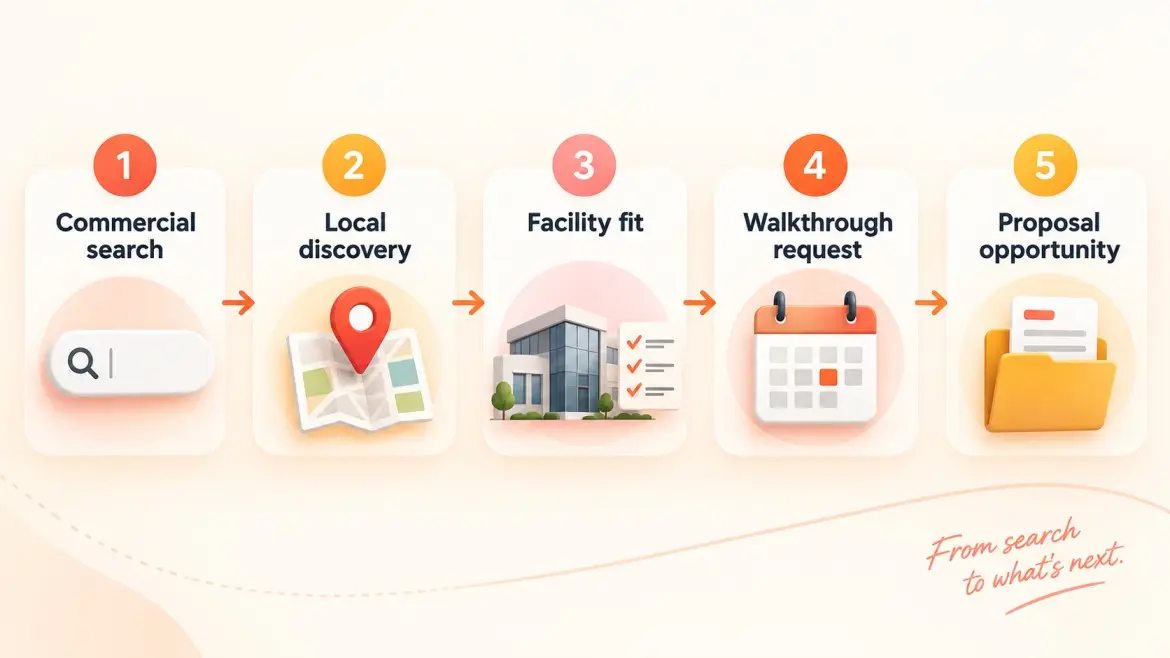
Commercial cleaning SEO helps a janitorial company appear when local businesses search for a provider. The goal is qualified visibility with buyers who need the right service, facility experience, schedule, and coverage area.
A search visit can become an inquiry, a site walkthrough, or a proposal opportunity. It does not become a signed contract by itself. Staffing, scope, credentials, pricing, references, follow-up, and the buyer’s process still matter.
This guide explains how to support recurring commercial work while filtering out residential and poor-fit inquiries. A commercial cleaning SEO plan should favor contract fit over raw traffic.
What Commercial Cleaning SEO Means for Contract Growth
Commercial cleaning SEO is the work of making a janitorial company easier to find and evaluate in Google Search, Google Maps, and related search experiences. It combines accurate local business data, useful service pages, strong technical performance, trusted third-party mentions, and a clear path to request a quote or walkthrough.
A sound commercial cleaning SEO program has two jobs. It helps search systems understand what the company offers, where it works, and which facilities it serves. It also gives a buyer enough information to decide if the company belongs on a shortlist.
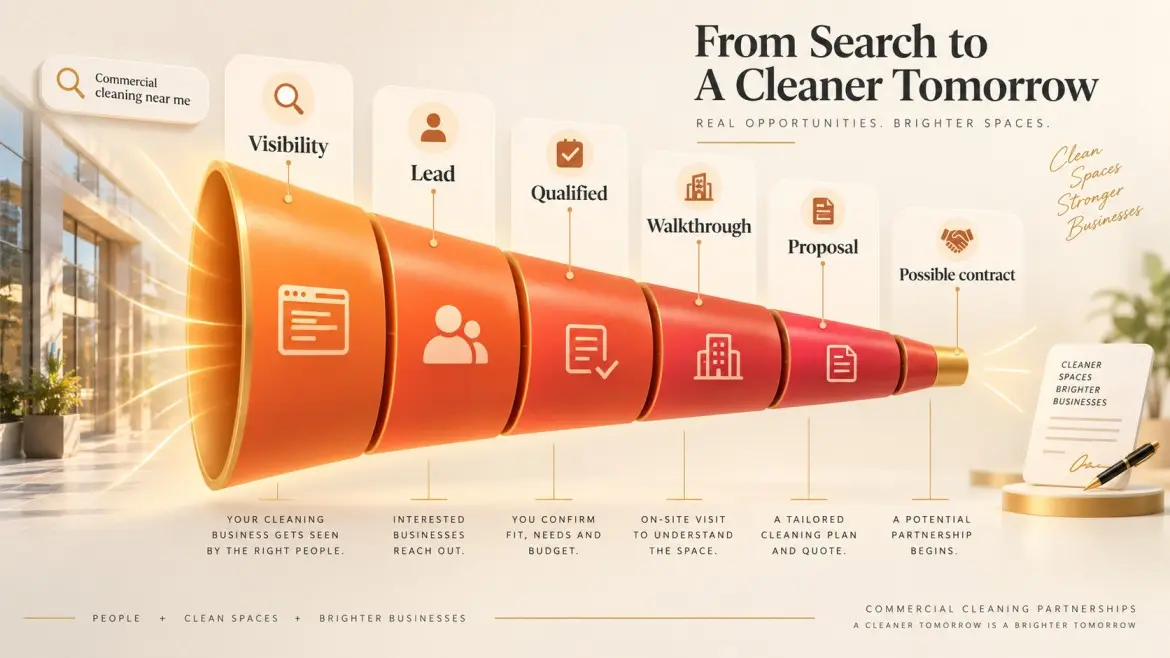
SEO for commercial cleaning companies can support several stages:
-
Visibility: A page or Google Business Profile appears for a relevant search.
-
Visit or profile action: The buyer clicks, calls, asks for directions, or opens the profile.
-
Lead: The buyer shares contact information.
-
Qualified opportunity: The facility, location, schedule, and scope fit the company.
-
Walkthrough: Both sides inspect the site and clarify needs.
-
Proposal: The cleaning company sends scope, price, and terms.
-
Signed contract: The buyer accepts after its own review and procurement steps.
These stages must stay separate. A ranking is not a lead. A lead is not always qualified. A proposal is not a contract.
A complete local SEO strategy should improve discovery and buyer evaluation, then make each stage measurable. Commercial cleaning SEO cannot replace sales follow-up or service delivery.
How Commercial Buyers Search Differently From Homeowners

Commercial buyers search for coverage, scope, building experience, schedule, and operational fit. Homeowners often search for a nearby cleaner, price, or a one-time task. A commercial page must speak to the people responsible for a facility and show that the provider can handle the work.
| Search factor | Commercial cleaning buyer | Residential cleaning buyer |
|---|---|---|
| Common need | Recurring janitorial work or a defined facility service | Home, apartment, or one-time domestic cleaning |
| Possible buyer | Facility manager, property manager, office manager, operations lead, procurement team, or owner | Homeowner or tenant |
| Search pattern | Office cleaning company, medical office cleaning, janitorial services near me | House cleaner near me, maid service, move-out cleaning |
| Evaluation | Coverage, scope, service window, staffing, process, relevant proof | Availability, price, convenience, home reviews |
| Next step | Qualification call, walkthrough, quote, bid, or proposal | Booking or estimate |
This difference changes keyword selection. “Cleaning business SEO” can cover both markets, so a commercial company should not build its whole plan around that broad phrase. Broad cleaning business SEO guidance often blends homeowners and business buyers. Pages should use precise buyer language such as office cleaning, recurring janitorial service, day porter service, warehouse cleaning, or medical office cleaning when those services are offered.
The same rule applies to content. A home-care guide may bring traffic without commercial demand. A page about office scope, after-hours access, quality checks, and service frequency can help a business buyer assess fit. Janitorial SEO needs that commercial detail. A janitorial SEO strategy should also map each query to a real service, facility type, and service area.
Texas examples show how location and facility intent work together. “Office cleaning services Dallas” is more precise than “cleaning company Texas.” “Warehouse cleaning Fort Worth” signals a different building and buyer. Each page still needs original local information.
How Google Surfaces Local Commercial Cleaning Companies
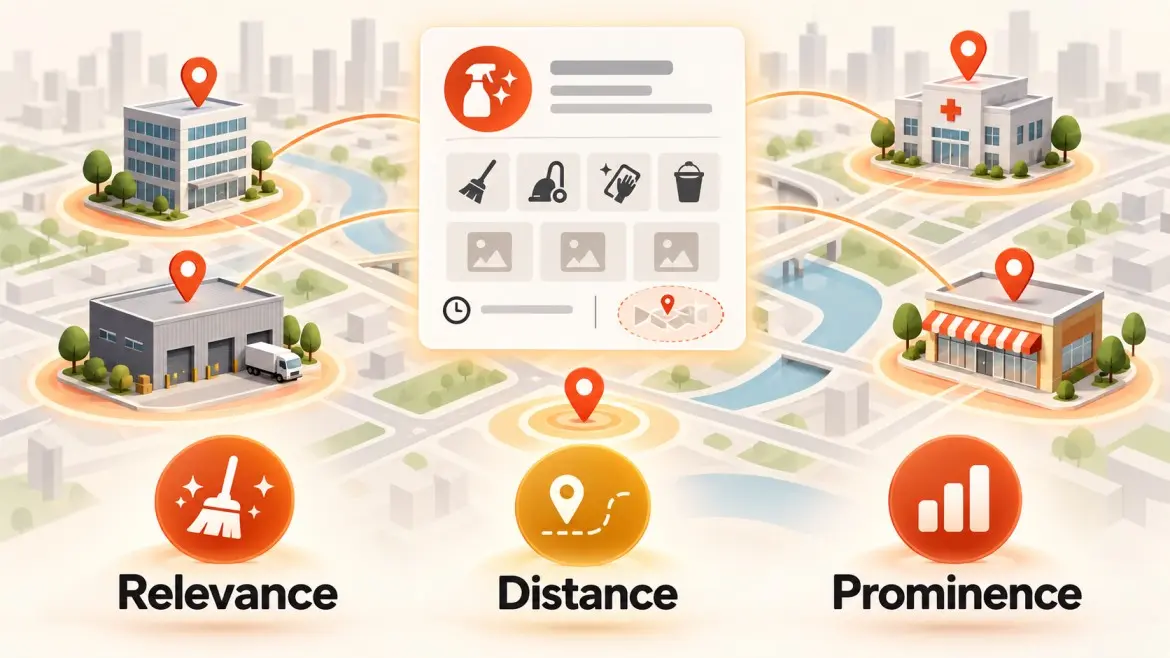
Google uses relevance, distance, and prominence to rank local results. Relevance is how closely a profile matches the search. Distance reflects the searcher’s location or stated area. Prominence reflects how well known a business appears. No profile edit can remove the real limit created by distance.
Google explains these factors in its local ranking guidance. Commercial cleaning SEO should support them with accurate information, useful pages, real reviews, and credible mentions.
Start with a verified Google Business Profile:
-
Choose the most specific primary category that describes the main business.
-
Add secondary categories only for real services.
-
Check current category options inside the profile manager. Do not invent a category name.
-
List commercial services in the services editor and write clear descriptions.
-
Describe the company, service scope, and coverage area without promotional clutter.
-
Keep the phone, website, hours, and other profile details current.
-
Add real photos of the team, equipment, vehicles, and commercial work when client permission allows.
Google says categories help connect a business with relevant searches, and the selected categories can affect local ranking. Its category guidance also makes clear that categories should describe what the business is. Service names and descriptions can be managed separately through the services editor.
Many janitorial companies operate as service-area businesses. If customers do not visit the business address, follow Google’s business representation rules and hide the address. Do not use a rented mailbox, virtual office, or fake location. Set accurate service areas rather than claiming every city in a state. Google currently allows up to 20 service areas and says the overall area should generally stay within about two hours of driving time, as explained in its service-area guidance.
Google Business Profile support can help a company review categories, services, profile accuracy, photos, and service-area settings. For commercial cleaning SEO, the profile and website should confirm the same service scope. Janitorial SEO becomes clearer when both assets use accurate commercial language. A profile for commercial janitorial work that links to a residential-only homepage sends a weak fit signal to buyers.
Build Pages That Prove Service and Facility Fit
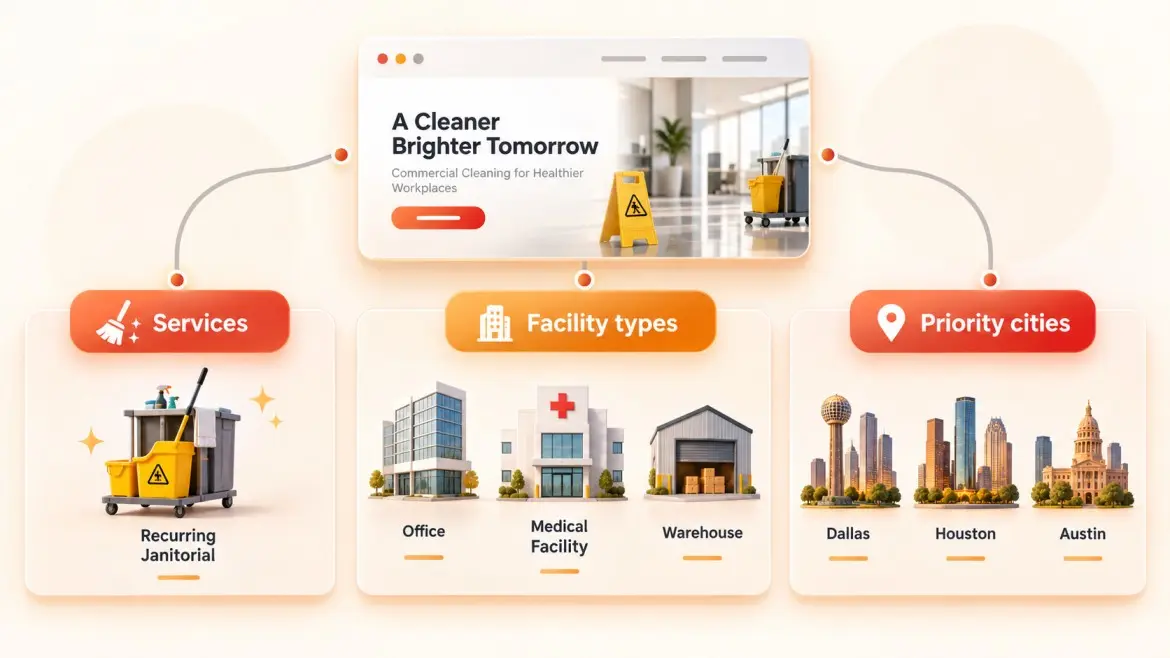
A commercial cleaning website should answer three buyer questions: Do you provide the service, do you serve the location, and can you handle this type of facility? Commercial cleaning SEO depends on a clear page structure that answers each question without thin or repeated city pages.
Build pages around real offers. Janitorial SEO also needs clear separation between broad services and facility-specific needs:
-
Service pages: recurring janitorial service, office cleaning, day porter service, floor care, or industrial cleaning.
-
Building-type pages: offices, medical facilities, schools, warehouses, retail sites, or multifamily common areas.
-
City or service-area pages: priority markets where the company can staff and serve the work.
A building-type page should explain the work, not repeat a label. A medical office page might cover the cleaning scope, scheduling options, communication process, and any true training or safety practices. It should not claim certifications, regulatory status, or infection-control expertise that the company cannot document.
Each core page needs:
-
A clear page title and H1 that match the service and location intent.
-
A direct opening answer that confirms service fit.
-
Specific scope, exclusions, frequency options, and service windows.
-
Coverage details and a link to related city or service pages.
-
Real proof, such as relevant photos, process details, or client feedback with permission.
-
A visible quote or walkthrough action.
Internal links should help buyers move between related needs. An office cleaning page can link to day porter service, floor care, and a Dallas page when each page adds value. Avoid a page for every small keyword change. Google’s SEO Starter Guide recommends content that helps search engines understand pages and helps people decide if they should visit.
Clear text also supports AI search visibility. Google says its AI features use the same core SEO practices and require no special markup. Important business information should be crawlable, written in text, supported by useful images, and linked from other relevant pages.
Use Proof, Reviews, Citations, and Links to Build Trust
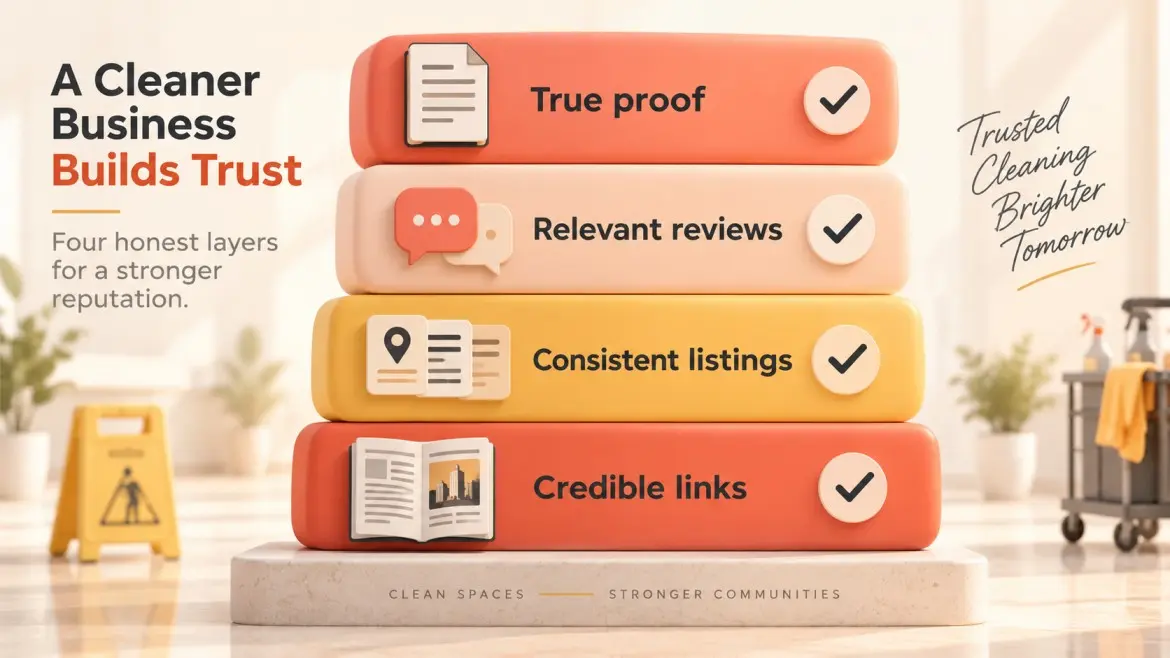
Commercial buyers need proof that matches their facility and scope. Search systems also need consistent information across the business profile, website, directories, and relevant third-party sites. The best trust work is accurate, specific, and hard to fake.
Publish trust details only when they are true:
-
Service scope and coverage area
-
Years in operation
-
Quality-control and communication process
-
Safety practices
-
Insurance, bonding, certifications, or background checks
-
Commercial references or approved client logos
-
Facility-specific photos and reviews
Insurance, license, bonding, safety, and procurement requirements vary by location and buyer. Publish current facts and verify local or contract rules before making a claim.
Reviews should reflect real customer experiences. For a company seeking office or facility work, feedback about recurring service, communication, schedule, and building type is more useful to a buyer than an unrelated home-cleaning review. Ask customers for honest feedback without telling them what words to use. Reply to positive and negative reviews in a clear, professional way. Google provides tools to read and reply to reviews.
Review management can organize the request and response process. Review count alone should not become the only target. Relevance, recency, detail, and response quality help buyers judge the business, while Google confirms that reviews and positive ratings can support local prominence.
NAP means name, address, and phone number. Keep those details consistent on the website, Google Business Profile, key directories, local business groups, and industry listings. Citation cleanup can correct old addresses, duplicates, and conflicting phone numbers.
Links from chambers, property associations, local publications, suppliers, community partners, or cleaning-industry groups may support authority when the relationship is real. Local link building should focus on relevant sites and editorial value. Batches of unrelated links create spam risk and do not prove trust.
Turn Search Visibility Into Qualified Walkthrough Requests
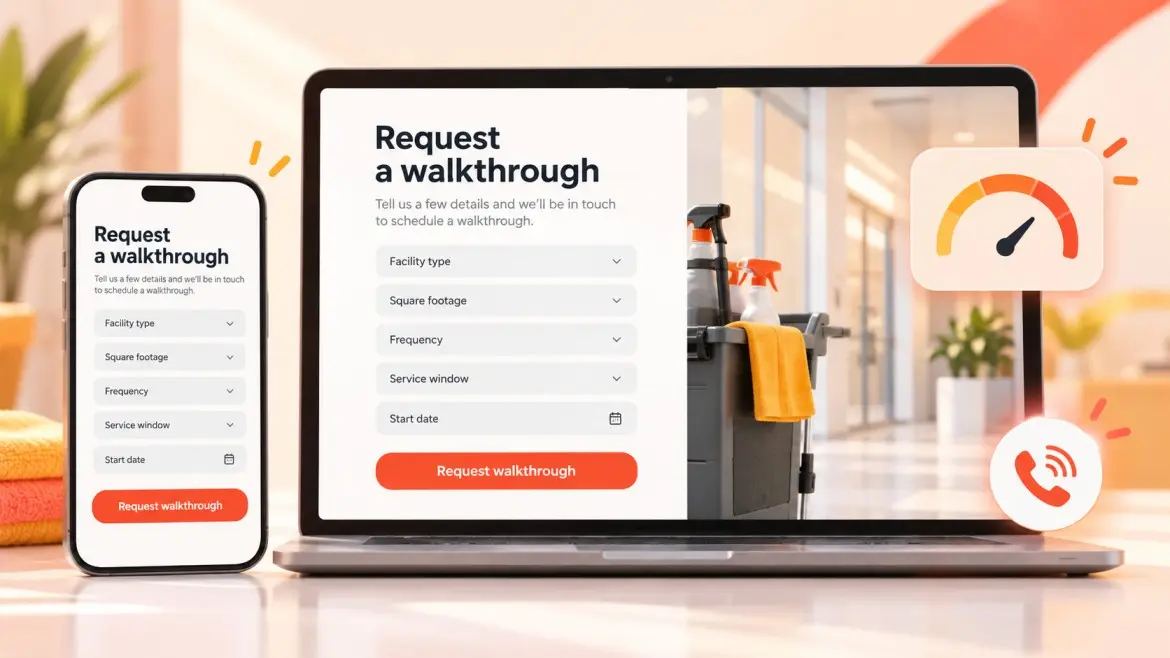
Commercial cleaning SEO creates value only when the right buyer can understand the offer and take a useful next step. The page should work well on a phone, load quickly, show contact options, and separate a facility opportunity from a residential request.
Google uses the mobile version of a site for indexing and ranking. Its Core Web Vitals measure loading performance, responsiveness, and visual stability based on user experience. A fast page also makes it easier for a busy facility manager to review scope and contact the company.
Use these conversion elements:
-
A tap-to-call button on mobile
-
A clear request-a-quote or request-a-walkthrough button
-
Short proof near the contact action
-
A form that works without zooming or horizontal scrolling
-
A confirmation message that explains the next step
Ask for fields that help qualification:
-
Contact name and work email
-
Facility address or ZIP code
-
Facility type
-
Approximate square footage
-
Service frequency
-
Preferred service window
-
Needed services
-
Desired start date
-
Walkthrough or proposal needs
Keep the first form short. Collect enough information to route the inquiry, then confirm details on a call or walkthrough.
Website speed and conversion support can help fix slow pages, mobile issues, weak calls to action, and long forms. Test every phone link and submission. Track the source while respecting privacy and consent rules.
Follow a Commercial Cleaning SEO Plan and Measure Each Stage
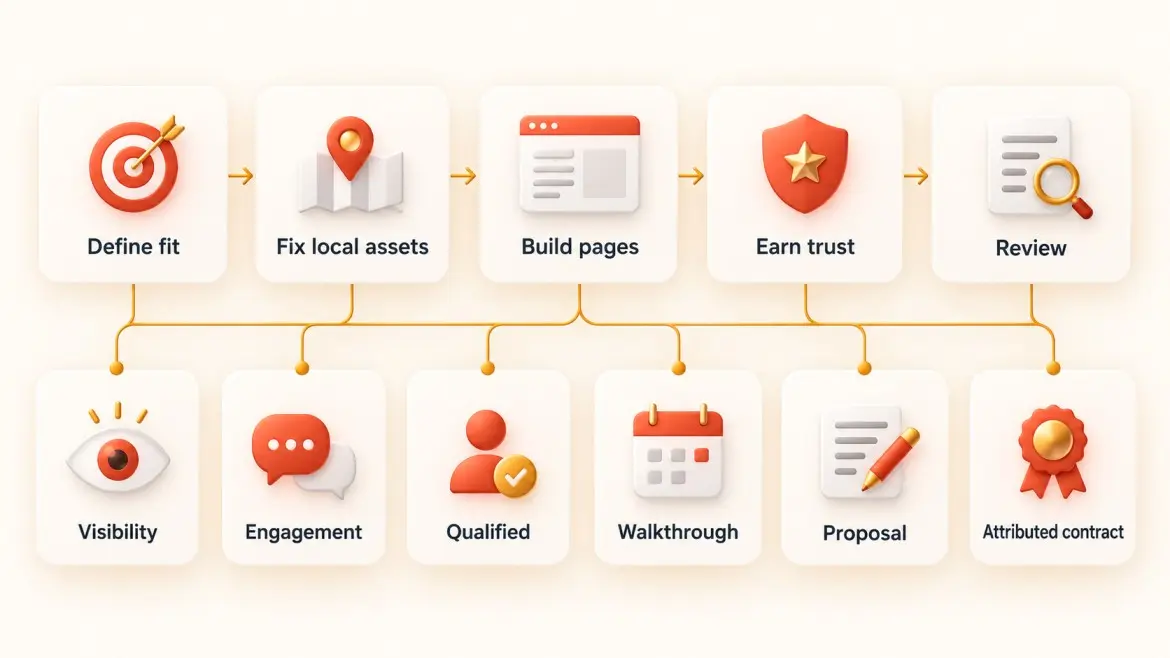
A useful commercial cleaning SEO plan starts with market fit, fixes the core local assets, publishes pages for real services, earns trust, and measures lead quality. The work should move in a clear order so a company does not chase rankings for services or locations it cannot support.
-
Define the best contract fit. List service areas, facility types, minimum or preferred scope, staffing limits, service windows, and services offered.
-
Research the local market. Review the local pack and organic results for core service, facility, and city searches. Note categories, page types, proof, reviews, and content gaps. Do not copy competitors.
-
Fix the Google Business Profile. Confirm eligibility, ownership, business name, address settings, service areas, categories, services, phone, hours, website, and photos.
-
Map keywords to pages. Give each core service, facility type, and priority city a clear purpose. Combine overlapping ideas instead of producing near-duplicate pages.
-
Improve core pages. Add direct answers, useful scope, proof, internal links, mobile contact actions, and qualification fields.
-
Clean business data. Correct NAP conflicts and duplicate listings on trusted directories.
-
Build reviews and authority. Request honest reviews after real service and earn relevant local or industry links.
-
Track traffic and pipeline stages. Connect calls and forms to source data where possible, then mark qualification, walkthrough, proposal, and contract status in a CRM.
-
Review and improve. Update weak titles, unclear pages, missing proof, and poor qualification paths based on real query and lead data.
Use Google Search Console to track impressions, clicks, click-through rate, average position, pages, and queries. The Search Console and Analytics guide explains how Performance reports help diagnose traffic changes. Add local rank tracking, but do not treat one grid or device as a complete market view.
Keep reporting in separate layers:
-
Search visibility: impressions, rankings, local pack presence
-
Engagement: clicks, profile actions, calls, form submissions
-
Lead quality: commercial fit, location, facility, scope, timing
-
Sales progress: walkthroughs, bid invitations, proposals
-
Business result: signed contracts with reliable source attribution
If a contract has several touchpoints, label organic search as an influence unless the source path is clear. Do not count residential calls as commercial leads.
For AI search visibility, publish clear facts, original expertise, and useful facility content. Google says pages in AI Overviews and AI Mode must be indexed and eligible for a Search snippet, with no extra technical requirements. Monitor Search Console, but do not claim that a format can secure an AI citation.
When to Hire Commercial Cleaning SEO Support
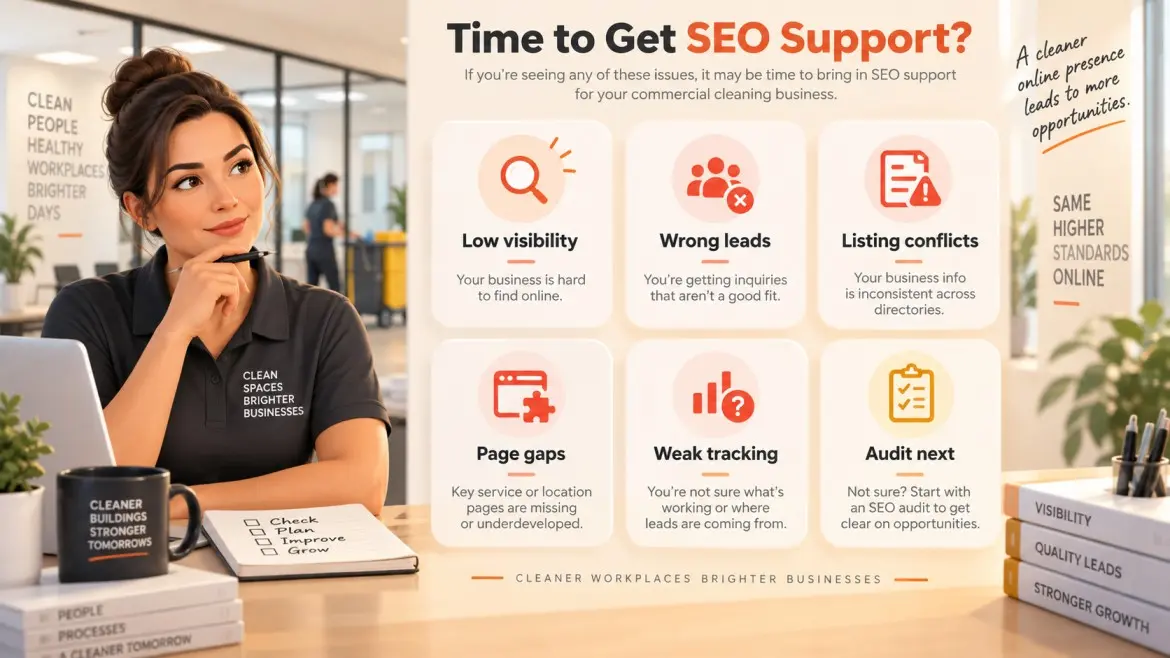
Professional help may fit when the company serves a defined market but does not appear for core services, receives residential inquiries from commercial pages, has conflicting listings, lacks useful facility pages, or cannot connect search activity to qualified opportunities.
Ask a provider how it handles service-area rules, categories, commercial intent, page quality, citations, reviews, links, mobile conversion, and reporting. Avoid promises of a fixed ranking, a set number of contracts, fake locations, copied city pages, or bulk spam links.
LocalHero reviews the website, Google Business Profile, citations, reviews, and local competitors. Start with a free local SEO audit to find the gaps that block qualified commercial visibility and walkthrough requests.
Frequently Asked Questions
What is commercial cleaning SEO?
Commercial cleaning SEO is the process of improving a janitorial company’s visibility in Google Search, Google Maps, and related search experiences. It helps search systems and business buyers understand the company’s services, service areas, facility experience, and contact path. The goal is qualified discovery and evaluation, not a promise that a search ranking will produce a signed contract.
How is commercial cleaning SEO different from residential cleaning SEO?
Commercial cleaning SEO targets business buyers, recurring services, facility types, service windows, walkthroughs, and proposal opportunities. Residential SEO focuses on homeowners, domestic tasks, availability, and booking needs. A commercial strategy should use office, medical, warehouse, retail, industrial, or janitorial language where accurate and should filter out house-cleaning inquiries.
How can a janitorial company rank higher on Google Maps?
A janitorial company can improve its Maps eligibility and relevance by keeping its Google Business Profile complete and accurate, selecting valid categories, listing real services, following address and service-area rules, earning honest reviews, and supporting the profile with a useful website. Google also considers distance and prominence, so no tactic can promise a top position everywhere.
Can SEO help a cleaning company win commercial contracts?
SEO can help a cleaning company become visible to suitable buyers and earn qualified calls, walkthrough requests, bid invitations, or proposal opportunities. SEO does not close the contract. The final decision also depends on service fit, staffing, credentials, pricing, the walkthrough, references, proposal quality, follow-up, and the buyer’s procurement process.
What should a commercial cleaning quote form ask?
A commercial cleaning quote form should ask for contact details, facility location, building type, approximate square footage, needed services, frequency, service window, and desired start date. It can also ask if the buyer wants a walkthrough or has a proposal deadline. Keep the first form short enough to complete on a phone.
Manal Ghamir
Co-Founder | Sales and Content Creator
Manal Ghamir is an SEO writer and co-founder of LocalHero. She helps brands and local service businesses create answer-first content that ranks on Google, appears in AI answers, and turns search visibility into leads. Connect with her on LinkedIn.
More local SEO playbooks
Ready to be the local hero in your city?
Get a free local SEO audit of your site, Google Business Profile, citations, and top three Map Pack competitors. You will see exactly where you can win in 30 seconds.
- No long term contracts
- No lock in
- Cancel anytime